CISA has added CVE-2026-85706 to its Known Exploited Vulnerabilities catalogue after citing evidence of active exploitation. GitLab says the critical path-traversal flaw could let an unauthenticated user read arbitrary files from an affected server through the repository commits API. The immediate response is therefore both patching and checking whether an exposed self-managed instance was accessed.[1][2]
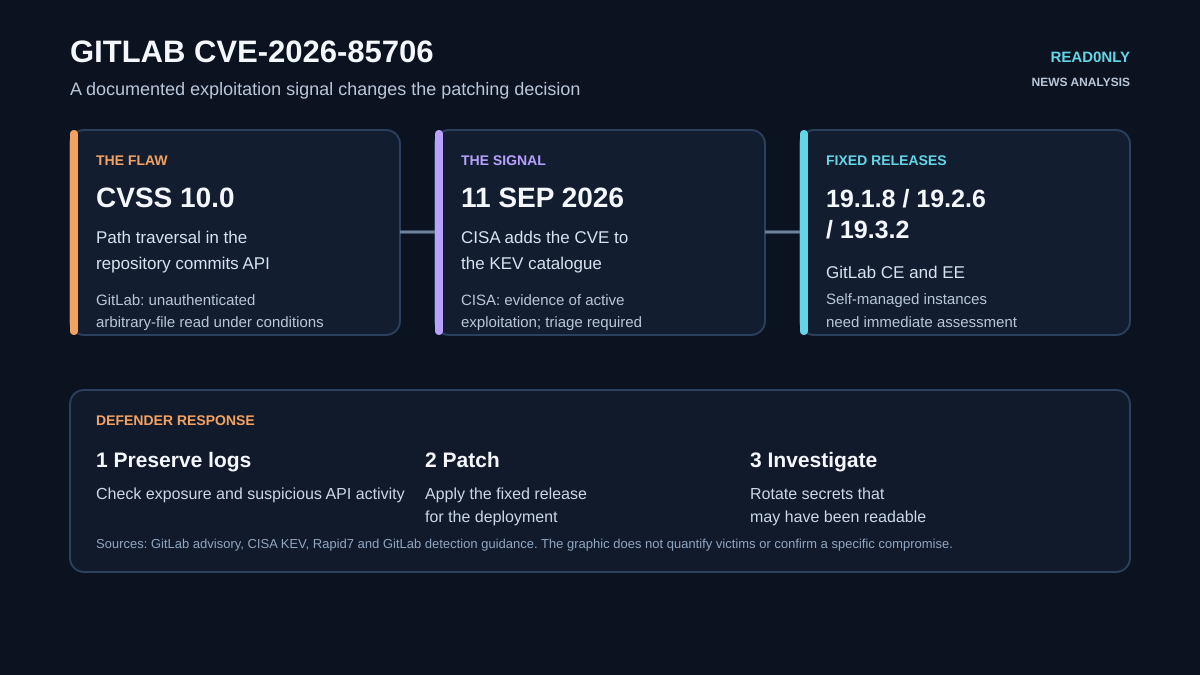
The vulnerability and the affected versions
GitLab describes CVE-2026-85706 as a path-traversal issue in the repository commits API. Under certain conditions, an unauthenticated caller could read arbitrary files because the request was not properly confined to the intended path and the endpoint did not enforce authentication as required.[1]
GitLab assigns the issue a CVSS 3.1 score of 10.0, with network attackability, low complexity, no privileges and no user interaction in the published vector. The score expresses the severity of the vulnerability; it does not measure how many installations were exploited or what an attacker obtained from a particular server.[1]
The affected ranges are GitLab CE and EE versions from 18.7 before 19.1.8, 19.2 before 19.2.6, and 19.3 before 19.3.2. GitLab’s fixed releases are 19.1.8, 19.2.6 and 19.3.2.[1] Rapid7 reports the same version mapping and says the vendor update is the available remediation for self-managed installations.[3]
The scope is important. GitLab says its hosted GitLab.com infrastructure is already patched and that GitLab Dedicated customers do not need to take action. The warning is aimed at self-managed deployments, including Omnibus, source-code and Helm chart installations.[1][3]
Why the KEV listing changes the response
CISA added the CVE to the KEV catalogue on 11 September, citing evidence of active exploitation.[2] The catalogue records a 14 September due date for the entry and marks forensic triage as required under BOD 26-04.[5]
The federal requirement applies to Federal Civilian Executive Branch agencies, not to every organisation running GitLab. CISA nevertheless encourages all organisations to prioritise KEV vulnerabilities through a risk-based vulnerability-management process.[2][5] Rapid7 recommends handling affected self-managed instances outside normal patch cycles and looking for signs of compromise even after the update has been installed.[3]
That distinction separates three actions which are often collapsed into one. Applying the fixed version removes the vulnerable code path. Reviewing access and application logs tests whether the instance may have been targeted. Rotating exposed credentials limits the value of any secrets that may have been read. The public notices support the first two priorities, but they do not provide a universal checklist for every deployment type.[1][2][3]
What defenders can look for
GitLab’s published detection material describes bursts of local-file-inclusion attempts involving an injected `file.path` parameter. The rule is designed for self-managed instances and looks for several distinct paths from one unauthenticated caller resolving outside the normal upload area within a short period.[4]
The same material says relevant events appear in `api_json.log` and can be integrated with a SIEM through GitLab’s audit-stream feature.[4] This is a detection approach, not a claim that every exploit attempt will produce an identical sequence or that a matching burst proves a successful file read.
The detection guidance identifies why the exposure can be serious. Depending on the installation and permissions, files of interest may include application configuration, secret material, database credentials, environment variables and private keys. The exact paths vary by installation method, so administrators should use their own deployment layout and GitLab’s guidance rather than assume that one fixed pathname covers every host.[4]
The safer operational order is straightforward: preserve relevant logs, establish whether the instance was internet-exposed, apply the fixed release, rotate credentials that could have been readable, and investigate suspicious requests before closing the incident. The first four steps are defensive recommendations based on the documented read capability and detection guidance, not evidence that any particular organisation suffered a compromise.[1][2][4]
What the record does not establish
CISA’s KEV entry confirms that exploitation was observed, but it does not publish a count of affected organisations or a measure of attacker success.[2] GitLab’s advisory identifies the vulnerable API, affected releases, fixed releases and three detection references, but it does not describe a public campaign timeline or name victims.[1]
Rapid7 says that, at the time of its 14 September publication, CVE-2026-85706 was the only vulnerability from the patch release known to be exploited in the wild. That statement is time-bounded and should not be read as a complete account of every exploit attempt or as proof that the other vulnerabilities in the release were harmless.[3]
The defensible conclusion is narrower than a breach headline. CVE-2026-85706 is a critical, remotely reachable file-read vulnerability in affected self-managed GitLab versions, and CISA has recorded active exploitation. Administrators of exposed instances need both a prompt upgrade and an investigation proportionate to the possibility that files were accessed.[1][2][3]
Sources
[1] GitLab Critical Patch Release: 19.3.2, 19.2.6, 19.1.8
[2] CISA Adds One Known Exploited Vulnerability to Catalog
[3] CVE-2026-85706: Critical GitLab Path Traversal Exploited in the Wild
[4] GitLab TLDR detection: local file inclusion path enumeration
 read0nly