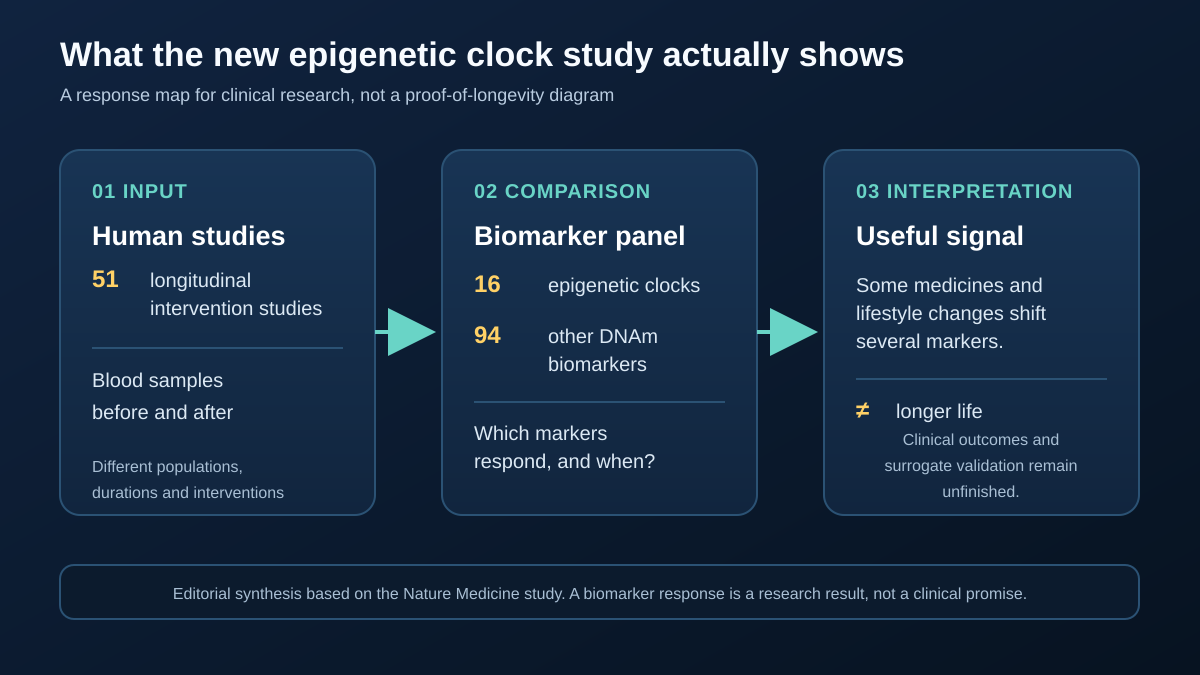
A study published in *Nature Medicine* has compared the way blood-based DNA methylation markers respond across 51 longitudinal intervention studies.[1] The result is useful, but narrower than the usual “anti-ageing” headline: some interventions change several biological-age measures, yet the study does not show that those changes extend human lifespan.[1]
The distinction matters because an epigenetic clock is a measurement system, not a time machine.[1]
What the researchers measured
The research team assembled the TranslAGE database and recalculated 16 prominent epigenetic clocks, alongside 94 other DNA methylation biomarkers, across the available studies.[1] The paper’s analysis used pre-intervention and post-intervention blood samples, with 3,128 samples included in the harmonised dataset.[1]
DNA methylation refers to chemical tags attached to DNA.[1] Their distribution changes with age and with aspects of health.[1] Epigenetic clocks use those patterns to estimate a biological characteristic, such as mortality risk, phenotypic age or the pace of ageing.[1]
They are therefore different from a person’s calendar age, and different again from a direct measurement of healthspan.[1][2]
The researchers grouped the interventions into four broad categories: pharmacological treatments, lifestyle changes, supplements and medical procedures.[1] The comparison was designed to ask which markers changed most consistently, not to determine whether one treatment was generally superior for patients.[1]
The strongest signal came from medicines and lifestyle changes
Across the 16 main clocks, pharmacological interventions had the largest average response.[1] The paper reports a mean effect size of −0.09307 for pharmacological interventions and −0.0393 for lifestyle interventions.[1] Both categories showed significant reductions in the pooled analysis, while pharmacological interventions were the only category with a significantly larger effect size than the others in the category comparisons.[1]
That result should not be read as a prescription.[1] The pharmacological group combined different treatments and patient populations, including metformin, semaglutide and anti-TNF therapies.[1] A pooled signal across such studies cannot establish that any one medicine slows ageing in every person, or that a biomarker change outweighs the medicine’s risks.[1]
The lifestyle result was less dramatic on average, but still important.[1] Yale’s summary of the study identifies combined healthy diet and exercise as the lifestyle pattern that most consistently reduced epigenetic age in the analysed data.[1] It also reports that over-the-counter supplements and some procedures did not show the same reduction.[2]
The paper’s intervention count gives a sense of the uneven picture.[1] Nineteen interventions significantly reduced epigenetic age across the 16 clocks, but only 13 remained significant after multiple-testing correction.[1] Five interventions increased it, and 26 showed no significant overall effect.[1]
This is a response map, not a league table of cures.[1]
The clock itself changes the answer
The clocks did not behave as interchangeable instruments.[1] The more recent generation of markers, including PCGrimAge, SystemsAge and DunedinPACE, showed stronger and more consistent responses than several older chronological-age clocks.[1]
DunedinPACE recorded significant decreases in 16 interventions and increases in only one in the paper’s first responsiveness analysis.[1] PCGrimAge produced the strongest statistical significance in the pooled clock analysis.[1] Those findings suggest that a trial asking whether an intervention changes the pace or risk-related features of ageing should not automatically use the same clock that best predicts chronological age.[1]
The study also tested “explainable” markers that break a composite score into system-level components.[1] This can preserve information that a single score may hide.[1] For example, the researchers report system-specific changes associated with lung, inflammatory, metabolic and musculoskeletal measures for different interventions.[1]
A global score that stays nearly unchanged may therefore coexist with a more local biological response.[1]
That is a useful design lesson.[1] It is not evidence that a particular organ has become younger.[1]
Health status altered the size of the signal
The response was generally larger in studies involving people with diagnosed disease than in studies of healthy participants.[1] In the paper’s comparison, several markers showed stronger decreases in disease populations, while fewer markers responded clearly in healthy groups.[1] The authors point to baseline physiological dysregulation as one possible explanation, while also noting that the clocks were trained in different populations.[1]
This boundary is easy to lose in a general-news summary.[1] A biomarker that is sensitive to change in a clinical population may behave differently in a healthy group.[1] Age range, intervention duration, sample size and study design also differed between the underlying studies.[1]
The practical consequence is straightforward: a trial cannot choose a clock in isolation.[1] It has to match the marker to the intervention, the population and the outcome the researchers ultimately care about.[1]
Why a younger-looking score is not a clinical outcome
The study was designed to describe biomarker responsiveness.[1] The authors explicitly say that the pooled analysis is not causal and that the underlying interventions are heterogeneous.[1] They also list missing harmonisation, differences in study quality and the absence of an empirically defined minimal clinically important difference for epigenetic clocks as limitations.[1]
That last point is the central brake on the headline.[1] Even if an intervention shifts an epigenetic score, researchers still need to establish what size of change matters for a person’s function, disease risk or survival.[1] A surrogate endpoint becomes useful only when it reliably stands in for an outcome that matters.[1]
The paper treats that validation as future work, not as a completed step.[1]
The result is still valuable.[1] It narrows the search space for clinical trials, identifies markers that appear more sensitive to intervention, and shows where a single biological-age number may be too blunt.[1] It also supplies a warning against treating all clocks as equivalent.[1]
For now, the most defensible reading is modest: some human interventions are associated with measurable shifts in DNA methylation biomarkers, and the shifts depend on the intervention, the marker and the people being studied.[1] Whether those shifts predict longer, healthier lives remains the question that the next generation of trials has to answer.[1]
 read0nly