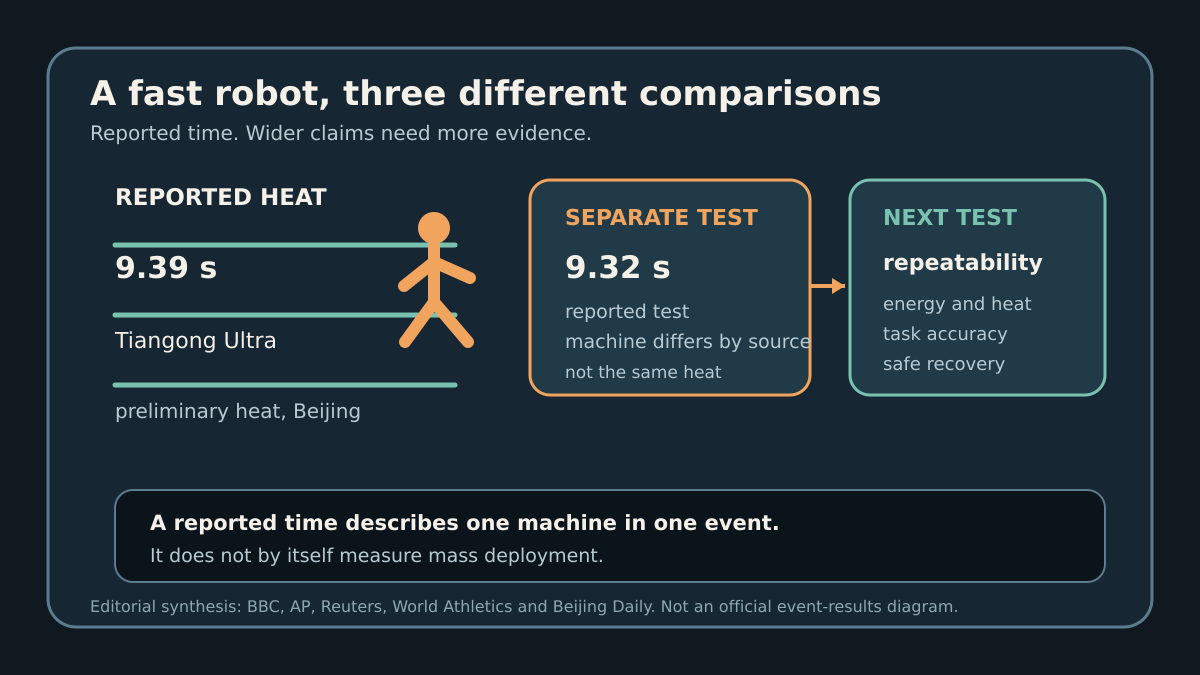
A humanoid robot reportedly ran 100 metres in 9.39 seconds at the World Humanoid Robot Games in Beijing.[1][5] The time came in a preliminary heat, according to Reuters and ABC.[3][5] It was faster than Usain Bolt’s official 9.58-second result from the 2009 World Athletics Championships, recorded with a +0.9 m/s wind.[4][5]
That is a striking reported result.[1][5] It is also a narrow one. The race reports show a large difference between the published times for this year and last year, but they do not establish a controlled rate of improvement for humanoid robots.[3][5]
The race result
Reuters, as republished by Internazionale, and ABC identify the winning machine as Tiangong Ultra, developed by the Beijing Humanoid Robot Innovation Center.[3][5] The BBC names the Beijing Innovation Centre of Humanoid Robotics, while AP attributes both race robots to Beijing-based X-Humanoid.[1][2] The accessible reports do not resolve whether these descriptions refer to the same corporate or research structure.[1][2][3] The article therefore treats the time as a consistent secondary report, not as an independently verified official timing record.
The numerical gap with Bolt’s official result is 0.19 seconds, or about 2 per cent of the human time.[4][5] That calculation keeps the headline in proportion. The robot and the athlete did not compete under a common technical protocol.[4][5] World Athletics records the human result and wind reading.[4] The accessible robot reports do not provide an equivalent official timing sheet, lane protocol or uncertainty figure.[1][5]
The sources also separate the race from another number circulating alongside it.[1][2][5] Reuters reported that Chinese state media said Honor’s Lightning had run 100 metres in 9.32 seconds during a preparatory test.[5] BBC described the same figure as a manufacturer-reported test, and AP attributed it to Honor.[1][2] The provenance is therefore different across the reports, and the 9.32-second figure must not be presented as an independently verified race time.[1][2][5]
A separate Beijing Daily report says Tiangong Ultra later ran 9.32 seconds and 9.34 seconds, so the machine attribution for the 9.32 figure is not settled across the reports.[6]
A large difference between two reported events
ABC and Reuters reported that Tiangong Ultra won the previous year’s 100 metres in 21.50 seconds.[3][5] Compared with the reported 9.39-second heat, that is a difference of 12.11 seconds, or roughly 56 per cent in elapsed time.[3][5]
The comparison is useful, but it is not controlled.[3][5] The reports do not provide enough detail about the two machines, software, battery state, track conditions, starting procedure or scoring rules to identify the cause of the difference.[3][5] Reuters also reported that Lightning’s legs were lengthened before this year’s games, showing why preparation and hardware changes matter when comparing event times.[5] The reported figures support a large change in published performance, not a causal explanation or a class-wide growth rate.
A race time compresses many engineering choices into one number. It describes the complete machine under the event’s conditions. The three main reports do not provide energy use, repeatability data, failure counts or a common protocol for comparing the two years.[1][2][3] Those omissions limit what can be inferred from the stopwatch.
The games are testing more than speed
The 100 metres was one of 51 events at the 2026 games, which ran from 22 to 26 August and included football, dancing and industrial-task contests, according to ABC and Reuters.[3][5] AP reports that the programme also included weightlifting and tug of war, with organisers saying that 16 countries were represented.[2]
A straight-line race does not test every property needed in an ordinary workplace.[2][3] The accessible reports do not provide results for perception, disturbance recovery, battery use, object handling or safety in routine settings.[2][3] This is a limit of the evidence, not evidence that the machines are unsafe or incapable of those tasks.
ABC describes precision tasks such as tightening screws, opening bottles and picking up beads as attempts to show abilities closer to work.[3] AP reports that experts still describe humanoid robots as being used mainly for demonstrations, performances and research, with mass deployment requiring more time.[2] The event can therefore be read as a public demonstration of selected capabilities, while deployment remains a separate question supported only by broader caveats in the reporting.[2][3]
What the result establishes
The available reports support several bounded conclusions.[1][2][3]
First, Reuters and ABC report a 9.39-second preliminary heat; the machine’s institutional attribution differs across the accounts.[3][5] Secondly, the official human comparison is Bolt’s 9.58-second 2009 result under a recorded +0.9 m/s wind.[4] Thirdly, the 9.32-second figure belongs to a separate reported test, but its machine attribution is not settled across the opened reports.[5][6] Fourthly, the 9.39-second and 21.50-second figures show a large difference between two reported events, but do not identify the reason for it.[3][5]
The checked sources do not establish a standardised robot equivalent of the human 100-metre record.[1][2][3] They do not show that every humanoid robot can approach 9.39 seconds, that the winning machine can repeat the time across many runs, or that the result predicts useful performance in factories, hospitals or homes.[2][3][5]
The stopwatch comparison is clear enough. The event record, test protocol and repeatability evidence are not.
Sources
- BBC — Watch: Moment humanoid robot beats Usain Bolt’s 100m record
- AP News — Chinese humanoid robots break human records at Beijing’s robot games
- ABC News / Reuters — Chinese humanoid robot beats Usain Bolt’s 100 metres world record
- World Athletics — Official 100 Metres Final, Berlin 2009
- Reuters via Internazionale — Chinese robots beat Usain Bolt’s 100m world record at Beijing games
- Beijing Daily — Tiangong Ultra reported follow-up times
 read0nly
Leave a comment