OpenAI announced GPT-5.6 for Kiro on 24 August, presenting Sol, Terra and Luna as models for planning, implementation, review and testing inside the AWS development agent.[1] The announcement reports that testing found GPT-5.6 Terra completed successful Terminal-Bench 2.1 tasks in Kiro at roughly 82% lower cost.[1]
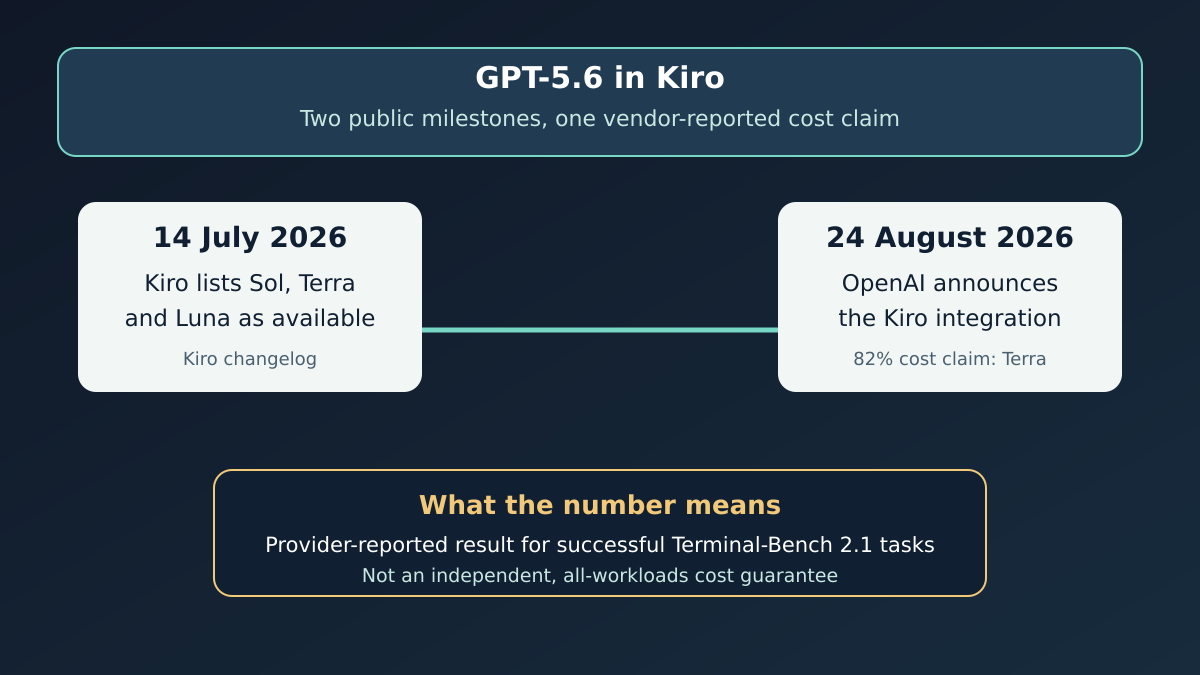
The model family itself had already been announced for general availability on 9 July, following a limited preview.[7] The 24 August post adds a Kiro-specific announcement and a reported cost result.[1] The relevant dates describe different milestones: model availability, a product record, a partnership announcement and a reported measurement.
Availability record and announcement are different milestones
Kiro’s own model changelog is dated 14 July and says that OpenAI models were available in Kiro for the first time.[2] It lists the same three models, their 272K context window and their initial Kiro credit multipliers: 2.4x for Sol, 1.2x for Terra and 0.6x for Luna.[2]
Kiro’s launch article tells the same story.[3] It says that the models were live across the IDE, CLI and Web, with experimental support for selected paid tiers and a gradual regional rollout.[3] The 24 August OpenAI announcement supports a Kiro announcement and a reported optimisation result, but it does not establish when Kiro first recorded GPT-5.6 as available.[1] The public records contain two different milestones: a Kiro availability/listing record dated 14 July, followed by the OpenAI announcement on 24 August.[2][3]
That distinction matters because a product launch date and a partnership announcement answer different questions.[1][2] The first tells readers when a feature was recorded as available.[2] The second tells them when OpenAI chose to announce the integration and attach a performance claim to it.[1]
What Kiro adds around the model
Kiro is not described by AWS as a model endpoint alone.[8] Its documentation presents an agentic coding service that turns prompts into specifications, code, documentation and tests, using several foundation models through Amazon Bedrock.[8]
The specification workflow is concrete.[5] Kiro can produce requirements.md, design.md and tasks.md, then track implementation through discrete tasks.[5] Its documentation also describes parallel execution for independent tasks and a correctness feature based on property-based testing.[5]
As an inference, those controls change the unit being evaluated.[5][8] A model answering a single prompt is one configuration. A model operating inside a system that prepares requirements, creates a design, schedules tasks and runs checks is another.[5][8] OpenAI does describe a spec-driven context around the result, including requirements, technical designs and task context.[1] It does not identify the complete run configuration: for example, whether parallel execution, property-based testing, particular feature flags, retry rules or reasoning settings were enabled.[1][5] Any cost comparison between the two can be useful, but it cannot be assigned to the model alone without a matched baseline.[1][5]
What the 82% figure establishes
OpenAI’s wording is specific: the result concerns GPT-5.6 Terra, successful tasks and testing on Terminal-Bench 2.1 in Kiro.[1] “Successful tasks” may condition the comparison on tasks that passed, while the public announcement does not say whether failed attempts, retries or unsuccessful-task costs were included.[1] It does not, on the page, provide the task count, the comparison configuration, the absolute costs, the accuracy difference, or a breakdown showing how much of the saving came from Terra and how much came from Kiro’s workflow.[1] It also does not define whether “cost” means Kiro credits, token charges, API dollars, compute or total successful-run spend.[1]
Terminal-Bench 2.1 is a real public benchmark, but its own release notes explain why version and environment details matter.[6] The revision changed 28 of 89 tasks, addressing external-dependency drift, resource mismatches and instructions that did not match their tests.[6] It also introduced continuous validation for agentic benchmarks.[6]
The release note does not independently validate or disprove the reported Kiro cost result.[1][6] It shows why benchmark version and environment details limit what can be inferred from it.[6] “Roughly 82% lower cost” is a provider-reported result for a named model, test configuration and success condition.[1] It is not evidence that every Kiro task costs 82% less, that Terra is 82% more accurate, or that the saving would survive a different task mix, model setting, region, retry policy or success definition.[1][6]
Kiro’s published model material adds another boundary.[3] It reports Terminal-Bench 2.1 scores for Sol, Terra and Luna, but those are model-performance figures, while the OpenAI announcement’s 82% number is a cost result for successful tasks in a particular Kiro setup.[1][3] The two measurements should not be merged into a single ranking.[1][3]
Availability has its own conditions
The Kiro documentation, checked on 25 August 2026 and marked updated 4 August, lists GPT-5.6 Sol, Terra and Luna for Pro, Pro+, Pro Max and Power tiers, with a 272K context window.[4] It defines the current relative credit cost against Auto at 1.0x.[4] A Kiro update dated 31 July says that Terra changed from 1.2x to 1.0x and Luna from 0.6x to 0.1x after OpenAI price changes, while Sol remained at 2.4x.[9] These are Kiro credit multipliers, not the undefined cost denominator in OpenAI’s 82% result.[1][4][9] It says that GPT-5.6 requests are served from the US, including for a Kiro profile in Europe.[4] The same documentation notes an exception for experimental features: those requests may be processed in commercial AWS Regions worldwide, including outside the profile’s geography.[4] That describes inference processing, not a change to where Kiro stores data.[4]
That is operationally relevant for teams evaluating the feature.[4] “Available in Kiro” does not mean identical access for every account, country or data-residency requirement.[3][4] Model availability, billing, experimental status and inference geography remain separate checks.[3][4]
What the evidence supports
The defensible claim is narrower than a general promise about cheaper AI coding.[1][2][3] OpenAI reported a cost reduction for successful Terra runs in Kiro, while Kiro’s records show an official availability/listing record more than a month earlier.[1][2][3] The benchmark release notes show why the exact environment and task definition matter, while the product documentation shows that Kiro’s specification workflow is context for the reported in-Kiro result.[5][6][8]
For a developer, the practical question is not whether “AI coding is now 82% cheaper”.[1] A decision-grade comparison would state the same repository, task set, model tier, acceptance tests, cost unit and baseline before reporting a saving.[1][5][6] Those details are still missing from the public announcement.[1]
Sources
- https://openai.com/index/gpt-5-6-in-kiro
- https://kiro.dev/changelog/models/gpt-5-6
- https://kiro.dev/blog/gpt-5-6
- https://kiro.dev/docs/models
- https://kiro.dev/docs/specs
- https://www.tbench.ai/news/terminal-bench-2-1
- https://openai.com/index/gpt-5-6
- https://aws.amazon.com/documentation-overview/kiro
- https://kiro.dev/changelog/models/gpt-5-6-lower-credit-multipliers-for-terra-and-luna
 read0nly