OpenAI says it banned a cluster of ChatGPT accounts that very likely originated in Russia and were used to promote the International Burke Institute (IBI), a self-described expert community based in Israel.[1] The company’s account is a report by the platform that investigated the activity, not an independent finding about every person associated with the institute.[1]
IBI published a statement on 26 August rejecting the allegations and describing itself as an independent institute that publishes original research with full source attribution.[8] The statement says that claims of foreign influence should be grounded in evidence rather than a chain of inference.[8] The Jerusalem Post reported the response on 27 August and attributed those claims to IBI.[9] IBI’s statement is a self-published denial, not independent evidence that overturns OpenAI’s account.[8][9]
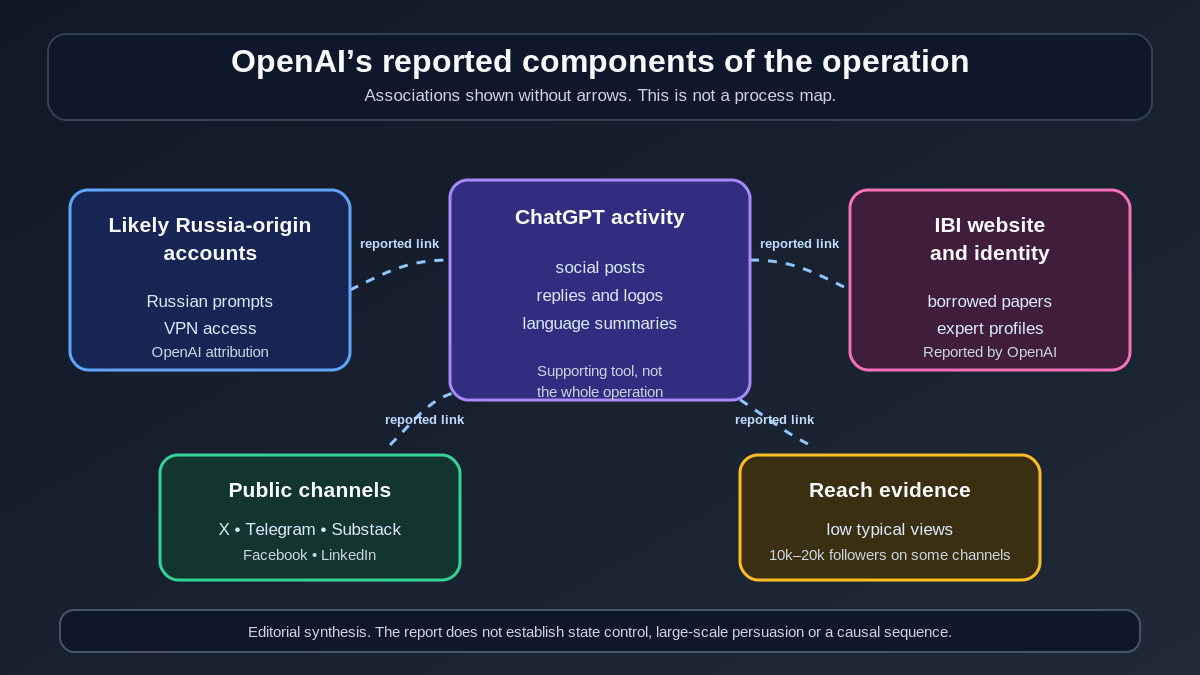
ChatGPT was one layer of the operation
OpenAI says it does not allow access to its models from Russia, and reports that the operators used VPNs to access the platform.[1] The operators prompted in Russian, while most of the comments generated were in English.[1] They also instructed ChatGPT to hide linguistic clues about their origin.[1] OpenAI says it found material posted on Substack, Telegram, X, Facebook and LinkedIn, including promotional posts and replies to genuine users.[1]
The distinction matters, but it is an interpretation of the report’s structure.[1] OpenAI does not say that ChatGPT generated the IBI website’s articles.[1] It describes the model as a supporting tool for posts that directed attention towards the site, while the wider operation included the apparent institution, its branding and its claimed research.[1] That is a narrower claim than saying that an AI model created the influence operation by itself.[1]
OpenAI also says that one operator used ChatGPT to generate German-language posts for a Telegram channel called Lahme Ente, which criticised Ukraine, the European Union and the German government while advocating better relations with Russia.[1] Another operator asked the model to generate logos for several channels and to summarise their activity in Russian.[1] These are reported examples of model use in the investigation.[1] They do not, on their own, establish who directed the wider operation or how much of the content reached real audiences.[1]
The website’s research presentation
OpenAI describes IBI as a self-described expert community with a broad roster of experts.[1] OpenAI says it reviewed a sample of 36 articles linked to people named as experts on the site, published between September 2025 and May 2026, and found that 34 had been copied from elsewhere on the internet.[1] The result is a sample finding reported by OpenAI, not a census or an independently published audit of the whole site.[1] The public report does not disclose a complete account sample, article inventory, text-matching protocol, audience-measurement table or the basis for its indication of breakout to authentic audiences.[1]
The displayed CPEC metadata can now be checked against the current IBI page and the underlying publication record.[1][2][5] OpenAI identifies an IBI article as apparently copied from a Cambridge University Press article but attributed to a different academic.[1] The current IBI page shows the title dated 28 December 2025 and credits Yunas Samad.[5] The Cambridge page identifies The China-Pakistan Economic Corridor: the Politics of Development as a research article by Yunas Samad and records its online publication date as 7 July 2025.[2] The University of Nottingham identifies Katharine Adeney as a Professor of Comparative Politics whose work has a particular focus on South Asia.[7] The current IBI and Cambridge pages establish that the title and Yunas Samad credit appear on both records.[2][5] The copying match and the reported different attribution remain OpenAI’s investigation, not claims made by Cambridge or Nottingham.[1]
The migration-governance example has a similar evidence chain.[1] OpenAI says an IBI article appeared to have been copied from the Migration Policy Institute and attributed to an Australian professor of food science.[1] The current IBI profile labels Kate Howell as belonging to the Migration Policy Institute.[6] The current IBI article page displays Migration Governance in Unsettled Times. How Policymakers Can Plan for Population Change, dated 21 January 2026, and credits Kate Hooper.[10] The Migration Policy Institute identifies the publication by its full title, names Meghan Benton, Natalia Banulescu-Bogdan and Kate Hooper, and labels it Report February 2025.[3] OpenAI describes Kate Howell as an Australian professor in food chemistry and links to a University of Melbourne profile.[1] The current IBI profile and article page therefore display different names for the profile and the linked publication.[3][6][10] The copying and misattribution analysis comes from OpenAI.[1]
As an article-level synthesis, these examples suggest that authentic publications and altered attribution were part of the site’s presentation of expertise.[1][5][10] They do not establish the operators’ full workflow, the legal status of the copied material or the complete provenance of every IBI article.[1]
Reach and infrastructure are different measurements
OpenAI says the immediate audience appeared limited: typical posts received low numbers of views and official IBI accounts had low subscriber numbers.[1] It also says that some Telegram channels associated with the operation generally had between 10,000 and 20,000 followers.[1] This article treats those figures as reported reach indicators, not measurements of readership, trust or behaviour.[1][4] This bounded source search located no independent forensic or audience dataset.
The report places the operation at the lower end of Category Three on the Breakout Scale, with some indications of breakout to authentic audiences.[1] Brookings describes the Breakout Scale as a framework based on observable, replicable and verifiable data, and defines Category Three by spread across multiple platforms and communities.[4] Here, Category Three is OpenAI’s application of the framework, not a separately published measurement by its authors.[1][4] This article treats Category Three as a distribution classification that does not by itself measure persuasion or behaviour change.[4]
In this article’s reading, the evidence supports a narrower distinction.[1] The operation appears to have assembled a cross-platform publishing and branding system, according to OpenAI’s investigation.[1] The checked sources do not establish large-scale persuasion, changed public behaviour or Russian state control.[1][4] OpenAI says some real people in Israel may have represented IBI, but that it could not determine their relationship with the Russian-origin operators, the institute or the website.[1]
What this case establishes
The best-supported conclusion is limited to the reported activity.[1] ChatGPT was used to produce promotional text, replies, logos and summaries inside a wider operation that presented a credible-looking information façade.[1] OpenAI’s report describes observed model use; it does not provide evidence that the model autonomously chose the target, built the institute or generated the copied academic articles.[1]
The practical lesson proposed here is to inspect provenance before judging whether a post “looks AI-generated”. A reader checking a similar case can ask who controls the account.[1] The reader can also check where cited research first appeared.[2][5] A further check is whether the claimed institution can document its experts.[3][7] These are proposed checks, not a tested ranking of investigative methods. In this case, the account relationships remain partly unresolved.[1] The current IBI pages make two displayed publication examples traceable.[5][10] The institutional records make the related identity records traceable.[3][7]
Sources
[1] OpenAI — Disrupting a new covert influence campaign from Russia
[2] Cambridge University Press — The China-Pakistan Economic Corridor
[3] Migration Policy Institute — Migration Governance in Unsettled Times
[4] Brookings — The Breakout Scale
[5] International Burke Institute — CPEC article
[6] International Burke Institute — Kate Howell profile
[7] University of Nottingham — Katharine Adeney
[8] International Burke Institute — Statement
[9] The Jerusalem Post — OpenAI links Tel Aviv-based think tank to Russian influence operation
[10] International Burke Institute — Migration Governance article
 read0nly