A study published in Science reports that El Niño events in the eastern equatorial Pacific have become markedly more variable in recent decades compared with the previous millennium.[1]
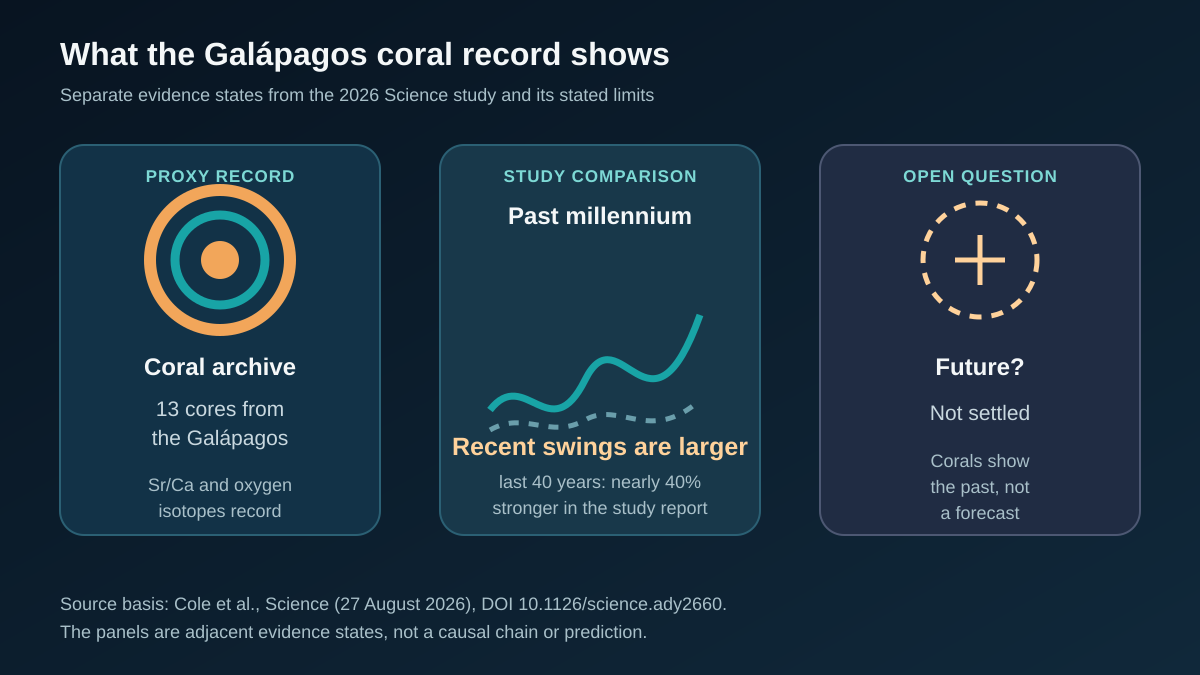
The paper is based on the chemistry of modern and ancient coral skeletons from the Galápagos Islands, where El Niño has a strong local signal.[2] The University of Michigan, which announced the study, says the events of the last 40 years were nearly 40% stronger than those of the pre-industrial era and stronger than any events in the preceding 1,000 years, up to about 1850.[2]
That is a result about a regional climate record and a defined comparison period.[1][2] It is not a claim that every El Niño behaves in the same way, or that the future path of the cycle is already known.[1][3]
What the corals record
The research team sampled cores from 13 corals, including living colonies and boulders of ancient coral, at Galápagos sites.[2] Coral skeletons grow in layers of calcium carbonate.[2] The chemistry of those layers contains information about the seawater conditions in which the coral formed.[2]
The researchers measured the ratio of strontium to calcium and also analysed oxygen-isotope ratios.[2] The University of Michigan describes both as temperature-sensitive measurements at the study site.[2] Read together, the cores provide a reconstruction of month-to-month to year-to-year sea-surface temperature changes far beyond the period covered by instrumental observations.[1][2]
The paper’s abstract describes the main signal as a large recent increase in interannual sea-surface-temperature variability in the eastern equatorial Pacific. It says the increase exceeds simulated natural variability and results from stronger El Niño events.[1]
The same abstract reports increased variability in central-Pacific coral data, although less distinctly than in the Galápagos record.[1]
The distinction between variability and the average state matters. The result does not mean that the Pacific is simply warmer by one fixed amount in every year. It means that the swings associated with El Niño have become larger in the eastern Pacific record examined by the authors.[1]
Why the location matters
El Niño is the warm phase of the El Niño–Southern Oscillation, a naturally recurring interaction between the tropical Pacific Ocean and the atmosphere.[5] NOAA says El Niño and La Niña events occur, on average, every two to seven years, but not on a regular schedule.[5]
During El Niño, weakened trade winds allow warm water to move eastward.[5] Changes in ocean temperature and atmospheric circulation can then affect rainfall, temperature, ecosystems and economies far from the Pacific.[5] The consequences vary with the event’s intensity, duration, timing and location, so a stronger signal in the Galápagos is not a universal forecast for every region.[4][5]
The eastern Pacific is important because it is close to the region where the strongest El Niño temperature anomalies are expressed.[3] Nature describes the Galápagos as a place that can capture the “heart of El Niño”, while also noting that relatively few corals survive there because of the harsh conditions.[3]
A new result in an unsettled field
The study’s comparison with climate-model simulations is one reason the authors connect the recent change with warming rather than with known natural forcings alone.[1][2] The University of Michigan reports that simulations using histories of volcanic eruptions and solar variability did not produce a comparable large shift in El Niño intensity over the past millennium.[2]
That evidence does not settle every question about attribution.[1][3][4] In a 2 June 2026 update, the World Meteorological Organization wrote that there was no evidence that climate change increased the frequency or intensity of El Niño events, while adding that a warmer ocean and atmosphere can amplify the impacts of associated extremes.[4] The WMO statement predates the Science paper, which was published on 27 August, so the two sources represent different points in a changing evidence base rather than a single agreed conclusion.[1][4]
Nature’s account also stresses that ocean and atmosphere feedbacks are complex and that reliable direct temperature measurements are scarce before the twentieth century.[3] The new coral record extends the evidence, but it does not remove the limits of proxy reconstruction or model disagreement.[1][3][6]
What it says about the future
The paper provides historical context, not a forecast.[1][3] Nature reports that many climate models project more frequent strong El Niños this century, but also quotes the study’s lead author warning that corals show the past rather than the future.[3]
Another 2026 modelling study found that ENSO responses to warming can be non-monotonic.[6] Its simulations strengthened ENSO under moderate warming, but projected a decline in amplitude under extreme warming beyond 2100, alongside changes in periodicity and event type.[6] That study is not a direct test of the Galápagos reconstruction.[6] It is useful here because it shows why a recent strengthening signal should not be converted into a simple statement that El Niño will grow stronger without limit.[6]
The most defensible reading is narrower.[1][3] The Galápagos coral archive records unusually large eastern-Pacific El Niño variability in the past four decades, compared with the preceding millennium.[1][2] The authors report that this recent increase exceeds the natural variability simulated in their experiments and parallels the rise in global temperature.[1]
The result strengthens the case for treating recent extreme El Niños as a serious climate-risk signal.[1][3] It does not provide a timetable for the next event, a regional impact map for every country, or certainty about how ENSO will respond at every future level of warming.[3][6]
Sources
[1] Science: Recent strengthening of eastern Pacific ENSO in the last millennium paleorecord
[2] University of Michigan: El Niños more intense over last 40 years than previous 1,000
[3] Nature: Why are El Niños getting stronger?
[5] NOAA: What are El Niño and La Niña?
[6] npj Climate and Atmospheric Science: Unraveling non-monotonic ENSO responses
 read0nly