GPT-5.6 is an API family with three named tiers: Sol, Terra and Luna.[1][2][3] Their model pages list the same nominal context window, maximum output, input and output modalities, and core Responses API features.[1][2][3] OpenAI’s launch record nevertheless reports different results between the tiers on its own evaluation tables, including long-context tasks.[5] This is a dated evidence synthesis of documentation and provider-reported results, not an independent benchmark or a prediction for a reader’s workload.
What is shared, and what is not
Sol, Terra and Luna each list a 1,050,000-token context window, a 922,000-token maximum input, a 128,000-token maximum output, text and image input, text output, and the same February 16, 2026 knowledge cutoff.[1][2][3] The cards present these as separate limits. Read0nly therefore does not treat them as a guarantee of 1.05 million input tokens plus 128,000 output tokens in one request.[1][2][3] Their catalogues also list the same reasoning-effort values, from none to max, with medium as the default.[1][2][3]
The model-card surface is therefore broadly shared.[1][2][3] The published role, displayed price and usage-tier limit are not.[1][2][3] The launch record also reports cross-tier evaluation results.[5] A shared context limit is capacity, not proof that the tiers retrieve or reason equally well near that limit.[5]
| Tier | Documented role | API model ID | Displayed text-token rate, 30 August 2026 | Model-card starting point |
|---|---|---|---|---|
| Sol | Flagship for complex professional work | gpt-5.6-sol |
$4 input / $20 output per 1M tokens | Complex professional work |
| Terra | Balances intelligence and cost | gpt-5.6-terra |
$2 input / $12 output per 1M tokens | A quality-cost trade-off |
| Luna | Cost-sensitive, high-volume work | gpt-5.6-luna |
$0.20 input / $1.20 output per 1M tokens | Cost-sensitive volume |
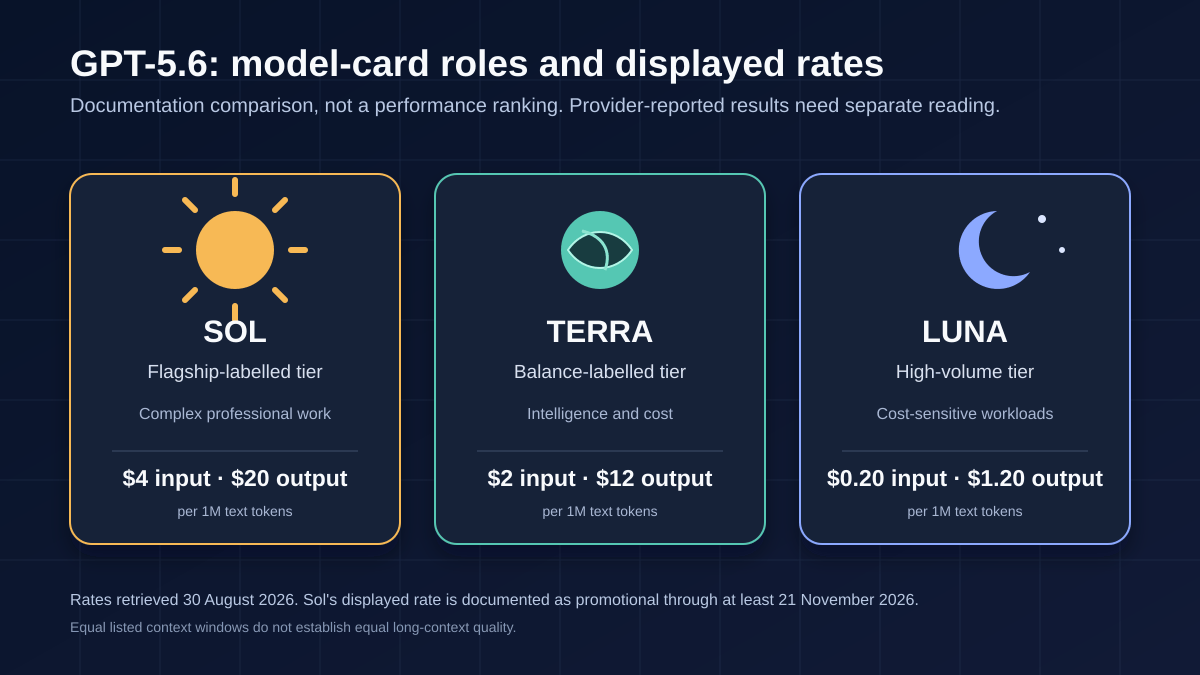
The table transcribes model-card roles and displayed rates retrieved on 30 August 2026.[1][2][3] Sol’s own page calls its displayed $4/$20 rate promotional and says the promotion is available at least through 21 November 2026.[1] OpenAI’s launch page also records an August update that reduced Sol’s API and credit pricing by more than 20% for three months.[5] The figures are useful for a scenario, but they are not durable price commitments.
Provider-reported performance: a boundary, not a ranking
OpenAI’s launch page contains cross-tier tables that the individual model cards do not.[5] In the page’s OpenAI MRCR v2 8-needle 512K-1M row, it reports 73.8% for Sol, 72.5% for Terra and 41.3% for Luna.[5] That row does not establish a general long-context ranking, yet it shows why equal nominal windows should not be read as equal long-context quality.
The same source also shows that a simple Sol-first ordering does not hold on every listed row.[5] Its NanoGPT row reports 9.69% for Sol, 14.5% for Terra and 1.66% for Luna.[5] These are provider-reported evaluation results with the source’s own conditions, not independent measurements and not evidence that Terra will outperform Sol on a particular production task.
For a deployment, Read0nly separates three evidence classes: model-card capability and pricing, vendor-reported evaluations, and the application’s own evaluation. The first describes documented interfaces and terms.[1][2][3] The second supplies comparative signals with vendor provenance.[5] For Read0nly’s decision method, which builds on the guide’s accuracy-first approach, only an application evaluation establishes whether a tier meets that application’s specific quality requirement.[6]
Cost: a reproducible but conditional example
At the displayed rates retrieved on 30 August, 10 million uncached input tokens plus 2 million output tokens calculate to $80 on Sol, $44 on Terra and $4.40 on Luna.[1][2][3] The arithmetic is $4×10 plus $20×2, $2×10 plus $12×2, and $0.20×10 plus $1.20×2. It is a token-price scenario, not an invoice forecast.
The three model pages list separate cached-input rates, and Sol’s page says prompts above 272,000 input tokens receive a different multiplier for the full request.[1][2][3] The cost comparison should therefore be read only as uncached text input and output at the retrieved rates. The current Sol rate also carries the promotional limitation stated above.[1]
A selection method, clearly labelled
The following is a decision rule, not a conclusion established by the three catalogue cards. OpenAI’s model-selection guide says to optimise for accuracy until the application reaches its target, then to seek the cheapest and fastest model that maintains that accuracy.[6] It also proposes testing a smaller model to see whether it retains accuracy at a lower cost and latency point.[6]
For workloads with hard cost or latency constraints, the guide says to set those thresholds before testing and remove models that exceed them.[6] Read0nly’s implementation of that general guidance is to start with a representative evaluation set, a stated error threshold and the real prompt, retrieval and tool configuration. It holds those choices and the scoring rule fixed across Sol, Terra and Luna, then compares cost and latency only among configurations that meet the quality threshold. This approach gives Sol’s flagship positioning a proper role: a starting candidate for difficult work, not a universal guarantee.[1][6] Terra and Luna become candidates to test for retained quality at lower listed rates, rather than automatic downgrades.[2][3][6]
The provider tables can help choose cases worth testing, especially near long-context boundaries.[5] They cannot substitute for an application evaluation, because the task, data, tool sequence and error costs may differ.
ChatGPT availability is a separate question
API availability and ChatGPT selection are not identical.[4] OpenAI’s Help Centre says that Sol powers paid ChatGPT reasoning options where available, while Luna is rolling out as the default for Free and Go users.[4] Terra and Luna are not selectable in ordinary ChatGPT conversations, although the article lists their availability in Work, Codex and the API according to product and plan.[4]
For an API system, the relevant materials are the API model cards, the time-sensitive price terms, vendor-reported results and a local evaluation. The ChatGPT model picker is not a complete view of the available API family.[4]
What remains unknown
This article does not supply an independent benchmark, a latency measurement, an invoice, or a universal accuracy ranking. The 1,050,000-token context window, 922,000-token maximum input and 128,000-token maximum output are separate model-card capacity limits.[1][2][3] RPM, TPM and Batch queue figures are separate caps that vary by API usage tier.[1][2][3] Neither field is presented by the cards as a measurement of achieved throughput or end-to-end latency.[1][2][3] Read0nly does not treat usage-tier caps as a promise of availability or sustained service at a given concurrency. The price example excludes cache mix, tools, retries, tax and any later change to the displayed rates.
In the model-card surface retrieved on 30 August, the practical difference is not a different basic API surface. It is a testable choice between a flagship-labelled tier, a balance-labelled tier and a cost-sensitive tier, made under explicit price conditions.[1][2][3] The application must check that choice against its own accuracy target.[6]
 read0nly