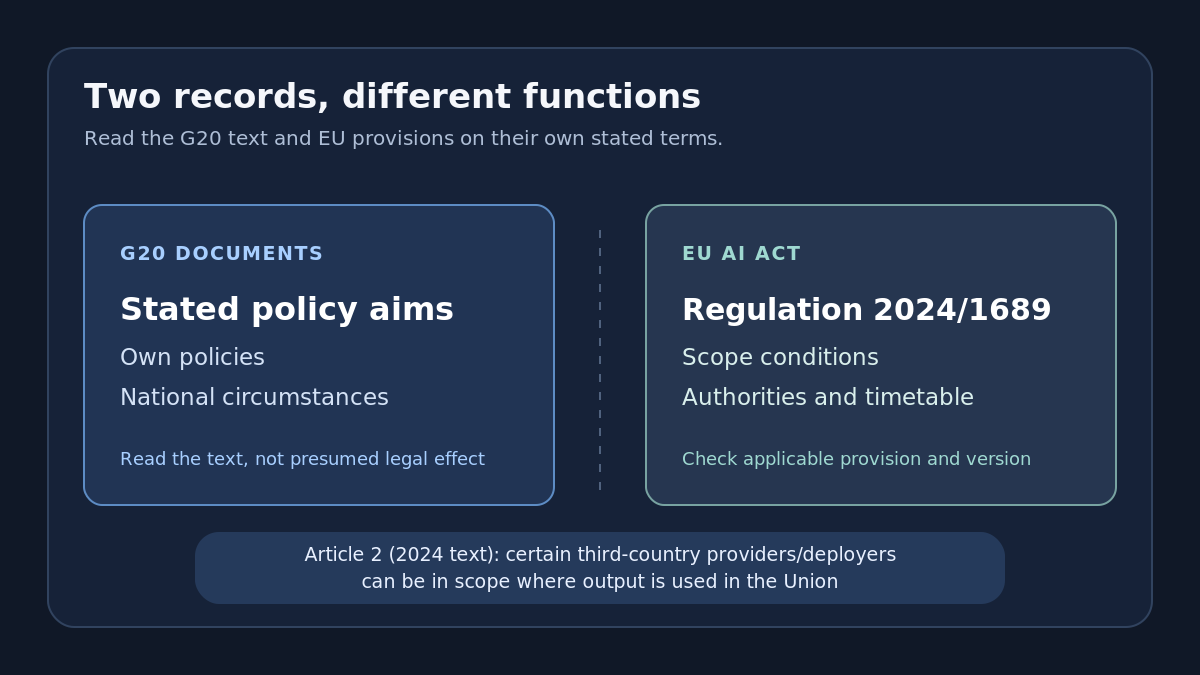
The Carolina Principles appear in the G20 Innovation Ministerial records as shared principles intended to inform national policy frameworks. The EU AI Act is Regulation (EU) 2024/1689. Reading the named records side by side can clarify their stated functions, but it does not decide their legal effect or any organisation’s obligations.[1][2][6]
The G20 documents set a policy direction
The Carolina Principles are dated 2 September 2026 and are reproduced by the G20 Information Centre with a US Commerce Department source link.[1]
The text says the principles should be applied flexibly in light of members’ legal frameworks, national circumstances and different technology maturity.[1]
It calls on members to develop their own policies and preserve national sovereignty in governing emerging technologies.[1]
The companion ministerial statement says ministers aim to build sovereign policy frameworks informed by the principles.[2]
Those phrases establish the documents’ stated policy direction. They do not, by themselves, identify a joint regulator, a shared compliance procedure or a mechanism that changes the EU Regulation.[1][2]
The Principles also support applying existing sector-specific regulatory frameworks where appropriate and focusing new regulation on considerations that existing frameworks cannot adequately address.[1]
That is a stated preference within the G20 text, not a finding about the operation of any individual jurisdiction’s AI rules.[1]
The EU materials describe a regulation and its administration
The European Commission identifies the AI Act as Regulation (EU) 2024/1689, a legal framework on artificial intelligence.[3]
Its current overview was last updated on 3 August 2026 and says that the AI Omnibus entered into force on 27 July 2026.[3]
Regulation (EU) 2026/1744 is an Official Journal act amending Regulation (EU) 2024/1689. Its Article 1 replaces Article 2(2) and Article 2(7), and adds Article 2(13); it does not amend Article 2(1)(c), whose output-used-in-the-Union condition appears below.[7]
The same Commission page describes a staged timeline. It says the rules for certain high-risk areas will apply from 2 December 2027, while rules for high-risk systems integrated into specified regulated products will apply from 2 August 2028.[3]
A separate Commission governance page says the AI Office, established within the Commission, and national market-surveillance authorities are responsible for implementing, supervising and enforcing the Act.[5]
The page also describes national authorities’ roles in supervising implementation at national level.[5]
The Service Desk identifies its Article 2 display as the official version of 13 June 2024 and links to the Official Journal text.[4][6]
For a decision on a specific obligation, exemption, date or enforcement case, the relevant official legal text and any later amendments remain the record to check.[3][6][7]
Scope is more than geography
The 13 June 2024 Article 2 text applies to providers placing systems or general-purpose AI models on the Union market regardless of whether they are established in the Union or in a third country.[4][6]
It also covers certain providers and deployers established or located in a third country where the output produced by the AI system is used in the Union.[4][6]
The same Article 2 page lists exclusions and boundaries. Examples include activities outside Union law, specified national-security and military uses, research and development before market placement or service, and certain personal non-professional use.[4]
The scope statement therefore does not mean every non-EU provider is covered, nor that establishment inside the EU is the only route into scope.[4][6]
The factual question is whether the actor, system, use and output fall within the conditions and exclusions in the applicable text.[4]
A document comparison, not a legal conclusion
The G20 documents describe shared policy aims while preserving members’ own policy choices and legal frameworks.[1][2]
The Commission pages describe an EU Regulation, a governance structure and an application timeline for particular classes of AI systems.[3][5]
That comparison is limited to what the named documents say. It does not determine the legal effect of the G20 instruments, resolve an individual organisation’s obligations, or show that either set of records changes the other.[1][2][3]
The next useful record for a company is a provision, guidance document, request or decision that identifies the relevant system, actor, territory and date. Article 2 is a starting scope check, not a complete compliance answer.[4][6]
Sources
[1] Carolina Principles for Emerging Technologies | G20 Information Centre
[2] G20 Innovation Ministerial Statement | G20 Information Centre
[3] AI Act | European Commission
[4] Article 2: Scope | EU AI Act Service Desk
[5] Governance and enforcement of the AI Act | European Commission
[6] Regulation (EU) 2024/1689, Official Journal text | Publications Office of the European Union
[7] Regulation (EU) 2026/1744, Digital Omnibus on AI | Publications Office of the European Union
 read0nly