OpenAI released GPT-6 Astra on 3 September. Its launch page says rollout began with a limited group of organisations before the API and paid ChatGPT plans; a current Help page lists GPT-6 Pro for eligible Pro, Business and Enterprise plans, not Plus in Chat.[1][2]
The release record and the access discrepancy
OpenAI’s 3 September launch page says Astra would become available through the API and to all paid ChatGPT plans over the following days.[1] The current Help page says GPT-6 Astra appears in ChatGPT as GPT-6 Pro for Pro $100, Pro $200, Business and Enterprise plans and is not included with Plus in Chat.[2] The two public pages therefore describe different access scopes. A buyer should check the current product page for its own plan rather than treating either page as a permanent entitlement record.
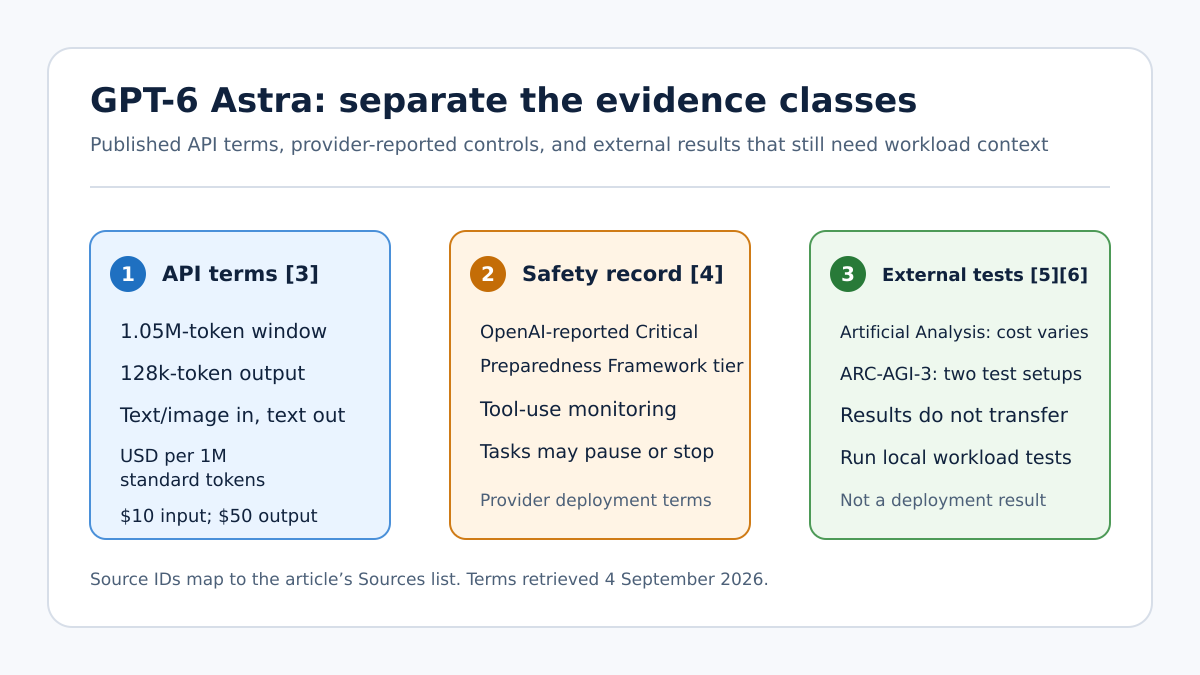
The API model page lists reasoning efforts from low through max, text and image input, text output, a 1.05 million-token context window, and a 128,000-token output cap.[3] For migrations, OpenAI’s guidance directs tool-calling users to the Responses API and says to remove temperature, top_p and top_logprobs.[7]
For EU data residency, that migration guide says Astra requires Standard processing and does not support Fast or Priority service tiers. Separately, OpenAI warns that extended prompt caching in regions without Regional processing may process and temporarily store Customer Content outside the selected region. These are deployment and compliance constraints, not latency measurements; teams with residency requirements need to validate their region, service tier and caching choice before migration.[7][9]
Rate scenarios are not task costs
The figures below are Read0nly calculations from OpenAI’s published standard token rates. They exclude tool charges, taxes, retries, Batch or Flex discounts, cache writes, regional-processing uplift, actual cache-hit rates and reasoning-token behaviour. They are rate scenarios, not bill forecasts or API measurements.[3]
| Scenario | Assumption | Astra standard-token cost |
|---|---|---|
| Single document task | 100,000 input tokens and 10,000 output tokens | $1.50 |
| Long-context request | 500,000 input tokens and 10,000 output tokens | $10.75 |
| Cached workflow | 100 requests, each with 20,000 new input tokens, 80,000 cached input tokens and 5,000 output tokens | $53.00 |
| High-volume workflow | 1,000 requests, each with 10,000 input tokens and 2,000 output tokens | $200.00 |
The second row applies OpenAI’s long-context multiplier because its input exceeds 272,000 tokens. The other rows do not.[3]
Artificial Analysis reports a different measurement surface. In its Coding Agent Index, it says Astra at max effort costs about the same per task as GPT-5.6 Sol at max while scoring two points higher, due to lower token use. In its Intelligence Index, it reports Astra and Sol both scoring 61 at max effort, with Astra about 75% more expensive per task after a smaller token reduction. Those are its measured configurations, not a forecast for another workload.[5]
A large context window is not a long-context result
ARC Prize reports 62.7% at $26,098 for Astra at max under its Standard test setup. Under its Provider Adapter test setup, which preserves opaque reasoning state and uses compaction, it reports 99.9% at $18,817 for Astra at high. The two figures answer different questions and should not be merged into one general context or cost claim.[6]
Artificial Analysis also reports mixed results across its constituent evaluations, including gains in some areas and regressions in GDPval-AA v2, tau3-Banking, SciCode and AA-LCR. That does not settle a customer’s use case. It does show why a listed context limit and a single benchmark result are insufficient selection criteria.[5]
The safety record is OpenAI’s classification
OpenAI says Astra meets its Critical threshold under the Preparedness Framework when supplied with the relevant tools and access. It also says advanced cybersecurity work is initially more restricted and that extra checks can slow, pause or stop legitimate work. Those are provider claims and deployment policies, not independently measured rates of misuse prevention or false interruptions.[4][8]
A decision rule before migration
Use a fixed evaluation set: prompt, retrieval corpus, tools, approval policy and scoring rubric should remain constant between the current model and Astra. Set a task-quality threshold before comparing cost and latency. Then record pass rate, human correction time, total token and tool cost, latency percentiles, refusals, and every monitor pause or stop.
Promote Astra only for task classes that meet the threshold under the relevant plan, region, service-tier and caching constraints. OpenAI’s documentation, Artificial Analysis and ARC Prize provide useful starting records. None can decide the result for an organisation’s own prompts, data, tools and approval rules.
Sources
- OpenAI, “GPT-6 Astra: A new generation of intelligence”
- OpenAI, “GPT-5.6 and GPT-6 Pro in ChatGPT”
- OpenAI, “GPT-6 Astra Model”
- OpenAI, “Safety overview: GPT-6 Astra”
- Artificial Analysis, “Benchmarking GPT-6 Astra”
- ARC Prize, “OpenAI’s GPT-6 Astra on ARC-AGI-3”
- OpenAI, “Model guidance”
- OpenAI, “Path to Astra: critical capabilities and frontier safeguards”
- OpenAI, “Data controls in the OpenAI platform”
 read0nly
Leave a comment