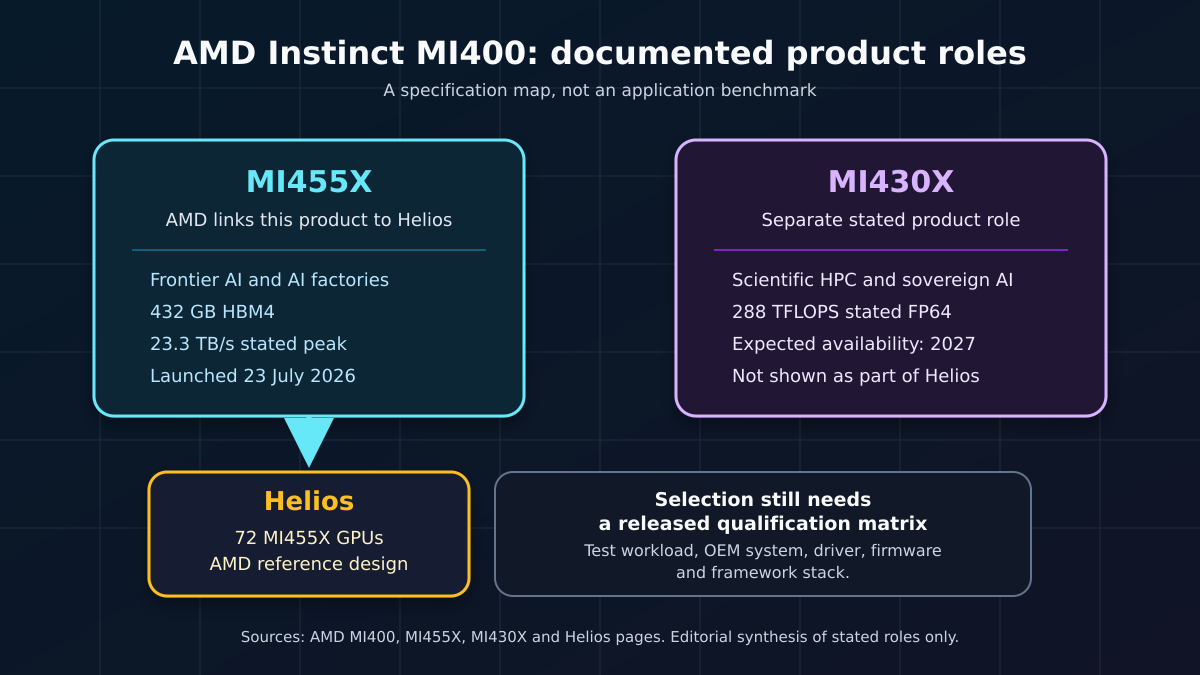
AMD has launched the Instinct MI400 family as two separately positioned accelerators. AMD describes MI455X as designed for the Helios reference design and frontier AI, while MI430X is described for sovereign AI and scientific HPC. The published specifications clarify those stated roles. They do not establish a cross-vendor performance ranking.[1][2][3][4]
What we know
AMD lists the MI455X as launched on 23 July 2026. Its published specification includes 432 GB of HBM4, 23.3 TB/s peak memory bandwidth and direct liquid cooling.[2]AMD’s Helios is a reference design, not a product sold by AMD. It integrates 72 MI455X GPUs with EPYC “Venice” CPUs and Pensando networking; AMD says volume deployments are expected in the second half of 2026.[4]
For MI430X, AMD lists up to 288 TFLOPS of hardware-based peak theoretical FP64, plus 432 GB HBM4 and 23.3 TB/s peak theoretical memory bandwidth. AMD says availability is expected in 2027.[3]
What we do not know
No independent application benchmarks, power figures, purchase prices or production-system availability data are used here. AMD’s comparisons and peak figures are vendor statements, calculations or engineering projections with stated configuration and release caveats.[2][3][4]Why it matters
The decision is not simply which accelerator has the larger quoted number. The documented distinction is between a rack-scale AI design centred on MI455X and a part intended to retain high FP64 capability for simulation while also running AI workloads. That creates different evaluation questions before either system can be selected.[1][2][3][4]
One family, two operating assumptions
AMD describes MI455X as a CDNA 5 accelerator made specifically for the Helios rack-scale design, for inference, training and fine-tuning. Its data sheet lists 256 work-group processors, 432 GB of HBM4 in 12 stacks, 23.3 TB/s peak memory bandwidth, 3.6 TB/s bidirectional scale-up bandwidth and 600 GB/s bidirectional UALink scale-out bandwidth.[2]
Those facts do not make a finished procurement specification. Helios is a blueprint for OEM and ODM systems, not a product for sale. A buyer should obtain the actual OEM configuration, support terms and qualification record before treating the reference design as a deployable system. AMD says the reference design uses 72 MI455X GPUs.[4]
MI430X starts from a different requirement. AMD positions it for scientific HPC and sovereign AI, and quotes up to 288 TFLOPS of hardware-based peak theoretical FP64 performance. It also lists 432 GB HBM4 and 23.3 TB/s peak theoretical memory bandwidth. The repeated memory figures matter because capacity and bandwidth are inputs to both model-serving and simulation design, but they do not tell a reader how a particular model or solver will run.[3]
FP64 is a documented factor for some workloads
One documented difference in AMD’s material is the published FP64 capability, which matters when a workload has a material double-precision requirement. MI455X lists 5 TFLOPS for peak vector FP64 and 5 TFLOPS for peak matrix FP64. MI430X is presented with up to 288 TFLOPS of hardware-based peak theoretical FP64.[2][3]
That is a specification-level contrast, not a measured speed-up. A simulation team still needs the numerical method, precision settings, memory footprint, communication pattern and compiler path before it can translate peak FP64 into time to solution. An AI team needs model architecture, context length, batch policy, quantisation, serving engine and cluster topology before it can translate HBM4 capacity or interconnect bandwidth into tokens per second.
This article’s decision method is deliberately narrow. For a workload with a material double-precision component, MI430X’s stated FP64 design point is a reason to include it in an evaluation. For large-scale training or inference, MI455X and the Helios system path are candidates to test in a specific OEM configuration. Neither statement is a performance ranking or a guaranteed fit.[2][3][4]
Shared software does not remove the test burden
AMD’s MI455X and MI430X product pages each list ROCm software support.[2][3] AMD describes ROCm generally as an AI and HPC software platform.[5] Within its rocSHMEM 3.6.0 entry, the ROCm 10.0.0 consolidated changelog lists single-node support for gfx1250 / MI455X.[7] That statement does not establish multi-node operation, OEM-board qualification, firmware compatibility, framework coverage or application behaviour. Separately, the official ROCm 10.0.0 compatibility matrix, dated 14 August 2026 and checked for this article on 5 September, does not enumerate MI455X or MI430X.[6] This is a dated, bounded document observation, not proof that either product is unsupported. The matrix also says ROCm depends on coordinated firmware, driver and user-space components. For selection, this article’s procurement rule is to obtain a released compatibility matrix or board-configuration guide for the proposed OS, driver, firmware and framework stack before selection.
A common software family could reduce maintenance work, but that is an editorial inference rather than a measured result in this article. It does not prove current framework maturity, kernel coverage, distributed-training behaviour or profiling quality for either MI400 product. Those remain version- and configuration-specific questions, and the relevant test is an application test plus a released compatibility record.
A decision record before a comparison
The original value in this article is a small decision record that keeps marketing claims separate from deployment evidence.
- Classify the workload. Record the share of runtime in FP64 simulation, low-precision training, inference, pre-processing and communication. A workload can use AI and simulation without needing one accelerator to be best at both.
- Fix the operating point. For models, keep context length, quantisation, batch size, framework, serving engine and concurrency fixed. For simulation, keep solver, mesh or grid, precision, MPI layout and accuracy target fixed.
- Measure the system, not a peak figure. Capture throughput, latency distribution, time to solution, memory use, power at the system boundary and failure or recovery behaviour on the intended OEM build.
- Separate availability from announcement. As stated in AMD pages checked on 5 September 2026, MI455X is listed as launched, Helios volume deployments are expected in the second half of 2026, and MI430X availability is expected in 2027. Those are different evidence states and should not be merged into one deployment date.[2][3][4]
This record cannot predict a winner. It can prevent an early category error: choosing a system because an advertised peak figure or an interconnect diagram looks appropriate for a workload that has not been represented in the test.
What the announcements leave open
The source set for this article is deliberately narrow: AMD’s launch page, the MI455X and MI430X product pages, the Helios page, the ROCm product page, the ROCm compatibility matrix and the ROCm consolidated changelog. It supports the product roles, specifications and dates quoted above. It does not support claims about delivered performance, energy efficiency, price, supply, software reliability or competitive outcomes.
AMD’s own notes make the limitation explicit. Its MI430X comparison calls the figure an engineering projection and says results are subject to change when products reach market. The Helios page identifies some rack figures as internal analysis and says actual results may change. These qualifications are part of the announcement, rather than small print to be removed from the comparison.[3][4]
For now, MI400 is a family with documented product roles. A purchasing conclusion still needs system-level workload evidence and a released compatibility record for the intended OEM build.
 read0nly