Anthropic says a team of Claude agents has completed a computer-checked formalisation of Fermat’s Last Theorem in Lean after 11 days of work. The theorem itself was proved by Andrew Wiles and Richard Taylor in the 1990s. The new result concerns the conversion of that mathematics into code that a proof assistant can check.[1][3]
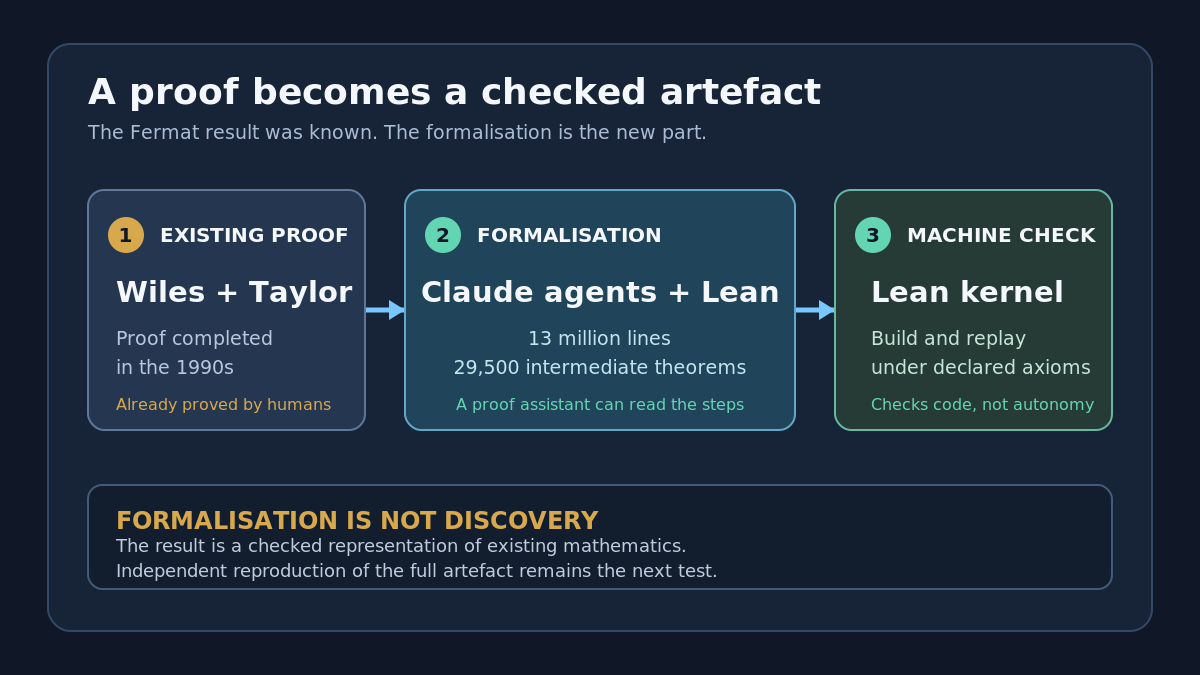
From a known proof to a checked artefact
Fermat’s Last Theorem states that no positive integers a, b and c satisfy an + bn = cn when n is greater than 2. For n equal to 2, Pythagorean triples provide counterexamples to the corresponding statement, including the familiar 3, 4, 5 triple.[3][6]
The modern proof is far removed from that short equation. It uses advanced number theory involving elliptic curves, modular forms and Galois representations.[4][7] The central R=T strategy relates a deformation ring to a Hecke algebra.[7]
Claude did not discover this mathematical route. The repository identifies the formalisation as following a version of the Wiles, Darmon, Diamond and Taylor argument, and credits earlier community projects and Mathlib.[1][2]
The difficult engineering task was to express the argument in Lean. Informal mathematical writing omits many steps that are obvious to a trained reader. Lean requires those steps to be represented in a form its kernel can check. A large project therefore becomes a dependency graph of definitions, lemmas and theorems rather than a single conversation with a chatbot.[1][5]
What the verification establishes
The repository says that the default build checks the theorem with Lean’s standard axioms and that it contains no added axiom, sorry, native_decide or unsafe declaration.[2] It also says that the theorem was checked against Mathlib’s own formulation and replayed through a second kernel.[2]
Taken together, those reported checks support a narrow conclusion: the published Lean artefact is reported to prove the stated Lean theorem under the assumptions of the Lean kernel and its checking tools. That is stronger than a plausible AI-generated explanation, but narrower than the claim that an AI independently created the underlying mathematics.[2]
The repository is also explicit about the cost of reproducing the checks. It reports roughly 67 GB of disk for the build, very high memory requirements, and additional time and memory for the comparator and second-kernel checks.[2] Those requirements matter because an open repository is not automatically an independently reproduced result. Reproduction requires the specified toolchain, hardware and commands[2].
The remaining boundary
The most defensible description is that Claude helped formalise an existing proof and produced an artefact that the project says has passed several machine checks. It is not that Claude has independently solved Fermat’s problem from first principles.
The next test is whether mathematicians outside Anthropic can build the repository and inspect the dependency chain. The repository describes itself as a research artefact that is not maintained and does not accept contributions, so its immediate value is better described as an open, machine-checkable representation than as a maintained library.[2] External reproduction would give the reported checks a stronger independent basis.
Sources
- Formalizing Fermat’s Last Theorem | Anthropic
- Fermat’s Last Theorem in Lean 4 | Anthropic GitHub repository
- Anthropic AI formalises proof of Fermat’s last theorem | Nature
- The Fermat’s Last Theorem Project | Lean community
- Prove2Me: An Open Collaborative Platform for Scaling Math Formalisation
- Pythagorean Triple | Wolfram MathWorld
- Formalizing Fermat’s Last Theorem in Lean | Lean Lang
 read0nly
Leave a comment