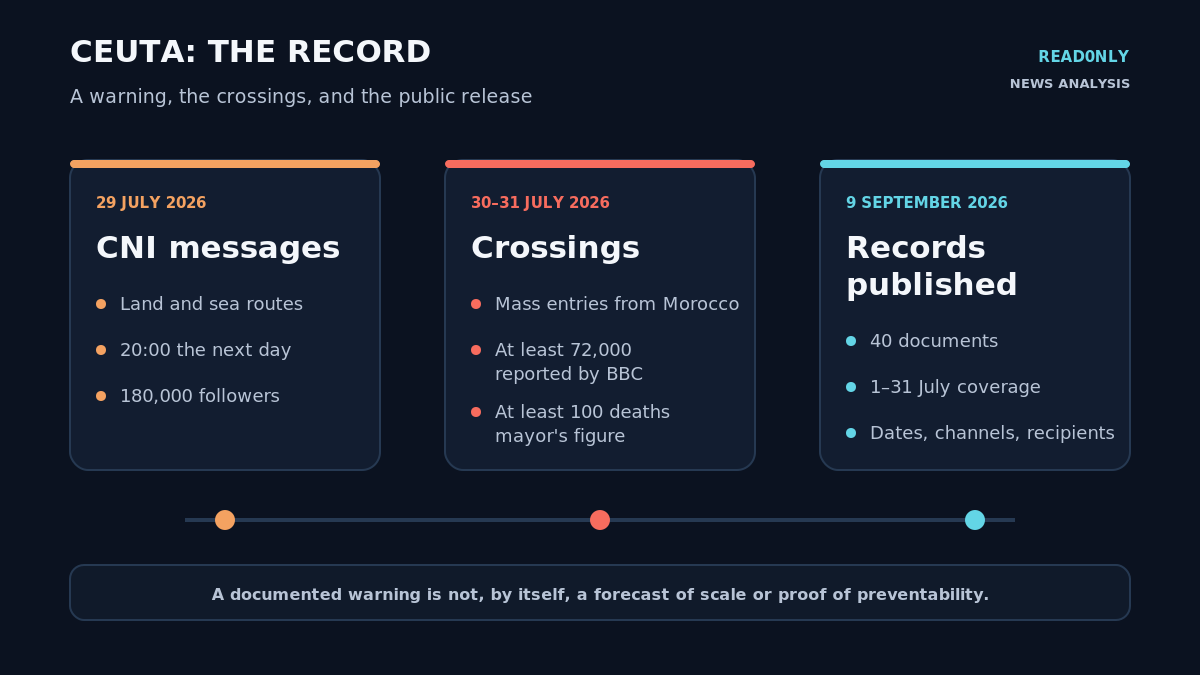
Spain has published 40 records and communications from July after a mass crossing into Ceuta from Morocco. The material includes 29 July messages from the National Intelligence Centre (CNI) about calls for people to enter by sea and over the fence the following day. It also leaves disputed what officials could have predicted.[1][2]
What Spain released
The Spanish government published the material on 9 September after the prime minister promised Congress that the public would be able to examine the information available to institutions during the Ceuta crisis.[1] The repository covers reports, alerts and communications issued between 1 and 31 July.
The collection contains 40 documents from the National Police, Civil Guard, CNI and Centre for Intelligence of the Armed Forces. The government lists each item’s date, transmission time, distribution channel and institutional recipients. It says personal information and operationally sensitive details were anonymised before publication.[1]
This makes the release an archive of records rather than a single account of the crisis. It shows what documents were made public and how they were circulated. It does not, without further evidence, resolve the political dispute over how those records should be interpreted.
The warning on 29 July
The official index records a CNI urgent note sent on 29 July at 18:26 to Morocco’s internal and external intelligence services. It also records CNI messaging with the Spanish government delegation in Ceuta and a communication with the Civil Guard on the same day.[1]
In the exchange with the Ceuta delegation, the CNI reported calls on social media for an attempt by land and sea at 20:00 on 30 July, taking advantage of Morocco’s Throne Day. The message said two groups had a combined 180,000 followers.[1][2]
The CNI’s communication with the Civil Guard referred to information about people attempting to swim and jump the fence the following day, and to Facebook and WhatsApp groups encouraging those entries.[1][4] The official page also records that the CNI sent a note about the planned crossings to Morocco’s DGST and DGED intelligence services.[1]
The timing is therefore documented. On 29 July, several communications about a possible crossing on 30 July were sent to Spanish and Moroccan institutions. The record does not show, by itself, how each recipient assessed the information or what decisions were made in response.
From a warning to a mass crossing
The crossings occurred on 30 and 31 July. BBC News reported that at least 72,000 people entered Ceuta during those two days and that at least 100 people died, citing figures from the mayor of Ceuta.[2] Al Jazeera also reported the 72,000 figure and described the newly released documents as showing a warning about possible mass crossings before the arrival.[3]
Those figures describe the reported outcome, not the size of the event forecast in the 29 July messages. The messages identified a possible time, routes and online mobilisation. They did not, in the material cited here, provide a numerical forecast of entries or deaths.[1][2]
The distinction is central to the dispute. The government says the messages did not constitute a formal alert and that the information available did not allow officials to anticipate the scale, nature or probability of what happened. The opposition says the warnings show that the government had been told enough to prepare.[2][4]
Both positions go beyond the simple existence of the messages. The documents establish that information was transmitted. They do not by themselves prove either that the crisis was foreseeable at its eventual scale or that it was unforeseeable.
What the documents establish
The public record supports a narrow chronology: a set of communications existed on 29 July, those communications referred to land and sea crossings on 30 July, and the government later released a wider collection of July records.[1] Reporting by BBC News and Al Jazeera supplies the account of the subsequent crossings and the political responses.[2][3]
Several larger questions remain open. The material reviewed for this article does not provide a complete decision log showing how every recipient acted after each message. It does not provide a firm causal test of whether additional preparations would have prevented deaths or reduced the number of entries. The released material includes attributed assessments about Moroccan conduct, but it does not independently adjudicate responsibility.[1][3][4]
The release does, however, change the evidentiary starting point. The question is no longer whether any warning was documented. It is what the warning meant in context, who received it, how it was assessed, and which actions followed. Those questions require the individual records and a careful separation between documented events, official explanations and political claims.
Sources
[1] Publication of the reports and communications on the situation in Ceuta
[2] Spanish intelligence warned of Ceuta mass crossing plans before surge
[3] Spain’s spy agency warned of mass crossings into Ceuta before border crisis
 read0nly