TypeSafe AI released Jev on 15 September 2026, calling it the first “System One model”: a class of AI trained to output typed decisions and calibrated probabilities instead of generated text.[1][3] The San Francisco startup, founded by former OpenAI and Google Brain researcher Diogo Almeida, prices the model at $42 per billion input tokens and says output tokens are free.[4][6][7]
A model that does not generate text
TypeSafe frames Jev as answering a specific gap. Large language models produce strings for a human reader, and software that wants a structured decision has to prompt the model into a particular shape, then parse and validate whatever comes back. TypeSafe’s documentation describes Jev as skipping that step entirely: it takes a `state`, the material to be judged, together with one or more typed `questions`, and returns typed answers with calibrated probabilities in a single parallel evaluation.[2][3]
The API exposes three question primitives. A Choice question picks one option from a fixed set and returns the chosen option, a probability for every option, and a confidence score. A Score question places the state on an ordered scale defined by the caller and returns a position on that scale plus the same probability and confidence fields. A Noul question asks a yes-or-no question and returns a single probability between 0 and 1, without a separate confidence value, since the probability itself is the signal.[2][3] All three can be mixed in one request against the same state, and TypeSafe says adding questions barely changes response time because they are evaluated in parallel rather than one after another.[2]
Calls go to `POST https://api.typesafe.ai/v1/systemone`, authenticated with a bearer API key, or through Python and JavaScript SDKs that default to the `jev-latest` model alias.[8] TypeSafe lists pricing at $42 per billion input tokens, with output tokens uncharged, which the company frames as roughly 238 times cheaper on input than what it calls Claude Fable 5.1.[7]
RLCD, and how TypeSafe frames it against RLHF
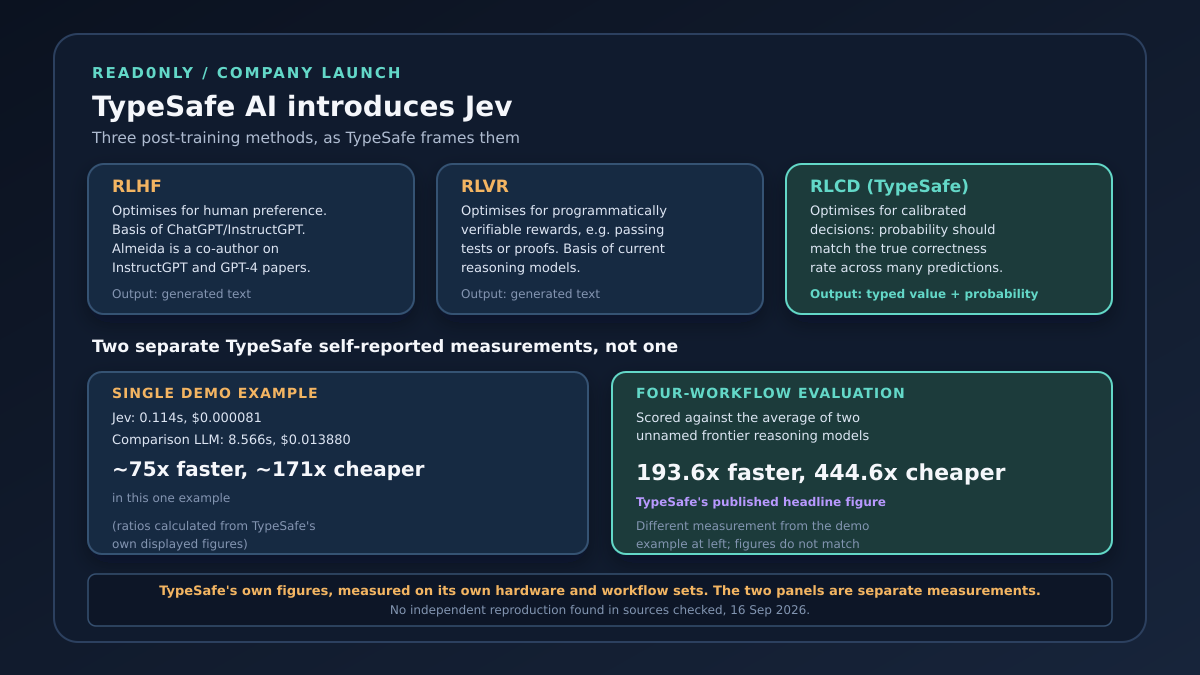
TypeSafe’s technical framing rests on a distinction between three post-training methods. Reinforcement learning from human feedback (RLHF) optimises a model to produce text that human raters prefer; the company says its own founder Diogo Almeida co-invented RLHF, and separately credits him with contributing to InstructGPT and ChatGPT. Reinforcement learning with verifiable rewards (RLVR) optimises for outputs that can be checked programmatically, such as a passing test or a correct proof, and underlies current reasoning models. TypeSafe’s own method, RLCD, optimises for a third target: a probability that is supposed to match the true rate at which an answer is correct, evaluated across many predictions rather than any single one.[4]
TypeSafe illustrates calibration with a simple rule: across many predictions, an answer the model marks with 20% probability should be correct about 20% of the time, and one marked 80% should be correct about 80% of the time.[4] The company’s confidence value, exposed on Choice and Score answers, is a single number derived from the shape of that probability distribution, concentrated when the model is sure and spread out when it is not; TypeSafe’s own guidance is to route high-confidence answers to automatic action, medium-confidence ones to a person or a secondary check, and low-confidence ones away from unattended action entirely.[2] Calibration, as TypeSafe defines it, is a property of a group of predictions, not a guarantee that any individual answer is right, a distinction the company’s own documentation states directly.[4]
TypeSafe argues that RLHF’s optimisation for human preference has a specific failure mode it calls mode dropping, where a model narrows toward a favoured style rather than representing genuine uncertainty, sometimes producing confident, fluent, wrong answers. Its documentation and launch post repeat the same framing: an LLM can hallucinate or refuse in ways a caller cannot predict from a schema, whereas a Choice or Score answer is mathematically constrained to the options that were supplied, so TypeSafe describes the model as unable to return a value outside that set. TypeSafe still separates that guarantee, about output shape, from a guarantee about correctness, which calibration addresses only as a group-level statistic.[1][4]
The published performance claims, with TypeSafe’s own caveats attached
TypeSafe’s headline figures, 193.6 times faster and 444.6 times cheaper, come from a set of internally built “workflow evaluations” rather than a standard public benchmark. The company says it constructed workflows meant to resemble production automation tasks, then scored every tested model against a reference answer built from the average of two proprietary frontier models it calls GPT-6 Astra and Fable 5.1, rather than against a fixed ground-truth label.[1]
TypeSafe discloses several limitations to that comparison in its own launch post. It says the published latency numbers were measured from its own laptops on the US West Coast, not from an independent testing environment. It says the workflows were authored by its own capability-team staff, which it acknowledges could introduce bias even though it states the workflows were not deliberately built to flatter Jev. It says using the average of two OpenAI- and Anthropic-style models as the reference answer likely biases the comparison toward those vendors’ style of answer, and that it therefore probably underestimates other vendors’ models, naming DeepSeek’s as an example. It also separately reports a side-by-side demo built on a short, dense input paragraph, which it says was chosen to emphasise the sampling difference and “paints our model in an advantageous light.”[1]
For the comparison LLMs in its evaluation, TypeSafe says it used its own open-source wrapper to force those models into the same typed-output schema Jev returns natively, and states this wrapper method is the most accurate way it has found to get structured decisions from an LLM, but that it is slower and more expensive than an unconstrained response. That framing means the comparison measures Jev against LLMs performing an added constraint-following step, not against those models answering in their native, unconstrained mode.[1]
TypeSafe publishes the underlying per-workflow numbers on a separate site, evals.typesafe.ai, covering four example tasks: security-incident triage, agent-trace observability, invoice processing, and customer service. Averaged across those four workflows, TypeSafe’s own figures put Jev’s accuracy at 67.8%, in line with several larger comparison models such as sonnet 5 (67.8%) and terra (67.9%), while Jev’s average cost and time per case, $0.0004 and 0.4 seconds, are markedly lower than every other listed model.[10] That average masks a wide spread at the individual-workflow level. On invoice processing, Jev scores 61.8%, trailing seven of the eight comparison models by 6.0 to 17.3 accuracy points while still beating the eighth (haiku 4.5) by 18.9 points. On security-incident triage, Jev scores 61.7%, third-highest of the nine models shown and 23.8 points ahead of the weakest comparison model on that task. TypeSafe presents evals.typesafe.ai as the detail behind the same four-workflow set referenced in its 193.6x/444.6x headline, though the exact arithmetic linking the two could not be reconstructed from the page’s visible per-model figures; the headline’s own comparison pair, described in the blog post as an average of two unnamed models it calls GPT-6 Astra and Fable 5.1, does not appear by name among the eight comparison models shown on the evals site.[1][10]
Who is behind it, and what is not yet public
TypeSafe’s team page lists three co-founders. Diogo Almeida, chief executive, is credited by the company with co-inventing RLHF and contributing to InstructGPT, and previously worked at Google Brain; independently, his publication record shows co-authorship of the InstructGPT paper and the GPT-4 technical report, both of which apply RLHF at scale, rather than the earlier papers that introduced the method itself.[4][6][9] Sasha Sheng, chief operating officer, is described as a former research engineer at Meta’s FAIR group who worked on News Feed and AI research and has publications at NeurIPS and ECCV. Erik Gafni, chief technology officer, is described as a repeat founder whose earlier company, Ravel, worked on multi-modal AI for DNA sequencing, and as an early employee at two companies that later reached unicorn valuations, Invitae and Freenome.[6] TypeSafe’s own materials describe the team as drawn from OpenAI, Google Brain, Meta/FAIR, Stripe, Airbnb, Plaid and Docker, working in person five days a week from a San Francisco office, and say the company is backed by unnamed “top-tier investors.”[6]
The searches carried out for this article found no independent funding disclosure, no named investors, and no third-party news coverage of the Jev launch beyond TypeSafe’s own site and documentation. That absence does not establish that no coverage or funding round exists; it reflects what was checked on 16 September 2026, the day after the announcement.[1][5][6]
What TypeSafe says Jev is for, and is not for
TypeSafe’s own positioning draws a boundary around the model’s intended use. Its manifesto states the company is not pursuing a single model that “does everything,” and instead wants narrow, typed judgements that sit inside code a developer already controls, contrasting that with an autonomous agent that chooses its own next action in a loop.[5] The company’s documentation gives worked examples along those lines: routing a support ticket to a department, scoring how frustrated a customer sounds, or flagging whether a message requests a refund, each expressed as a separate, narrow question whose answer a program can threshold, combine with other answers, or escalate to a person.[2][3]
That framing is also where TypeSafe places its own limits. Its documentation states that System One models are not meant to write replies, produce code, or explain their own reasoning, and that a judgement requiring extended, multi-factor reasoning should be decomposed into several narrow questions and recombined in ordinary code, rather than asked as one broad prompt.[2][3] Whether real deployments hold to that boundary, and whether the claimed efficiency gains persist on workloads TypeSafe did not choose and did not measure itself, is not something the current public record settles.
Sources
[1] Introducing System One Models & Jev – TypeSafe AI Blog
[2] Primitives (Questions) – TypeSafe AI
 read0nly