Paper2Agent is a framework that turns a research paper’s manuscript, code, data and workflows into an AI agent exposed through a Model Context Protocol (MCP) server. The Nature paper reports reproduced results, new queries and a gene-prioritisation case study, but its evidence remains a set of demonstrations rather than a guarantee that any paper can become a reliable research assistant.[1]
The input is more than a PDF
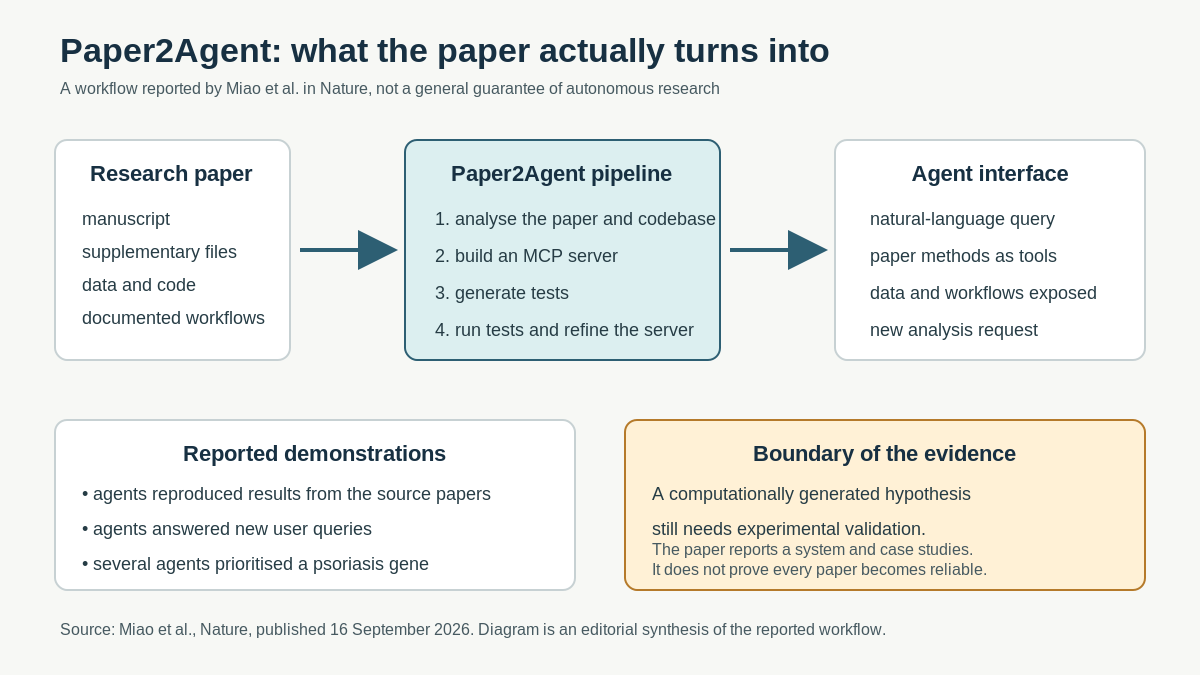
Paper2Agent starts with the research paper and the material around it. The authors describe a bundle that can include the manuscript, supplementary information, datasets, source code and documented workflows. The system then uses multiple agents to analyse those materials and expose the useful parts through an MCP server.[1]
That distinction matters. A language model with only the PDF can describe a method, but it cannot automatically run the paper’s implementation or inspect the data behind a result. Paper2Agent’s target is an executable interface: a user asks a question in natural language, and the connected agent can call tools built around the paper’s methods and resources.[1]
Testing is part of the conversion
The framework does not stop after generating an MCP server. It also generates and runs tests, then uses the results to refine the server. The authors present this as a way to improve the reliability of the paper agent before a user starts asking it new questions.[1]
The paper’s case studies show why that check is useful. The authors say Paper2Agent-created agents reproduced results from the original papers and carried out new queries. Those are stronger demonstrations than a system that merely paraphrases a manuscript, although they still depend on the selected papers, environments and tests used in the study.[1]
A case study is not a lab result
One demonstration combined agents based on AlphaGenome with an ADHD genome-wide association study dataset. The system prioritised one variant among 209 candidates and used AlphaGenome to generate a possible mechanism involving splicing and expression in neurons. The paper describes this as a candidate hypothesis, not as an experimentally confirmed causal finding.[1]
That boundary is the important part of the result. An agent can expose a method, run a workflow and produce a plausible next experiment. None of those steps removes the need to check the input data, the generated code, the model assumptions or the proposed biological mechanism. The paper shows a route from publication to interactive analysis; it does not show that the route is safe to use without scientific review.
What the framework changes for readers
Today, reusing a computational paper often means moving between several surfaces: the article, a repository, a package manager, a dataset host and local configuration. Paper2Agent tries to put those surfaces behind one tool interface. For a reader, the practical gain would be less time spent learning the shape of an unfamiliar codebase before testing a method.
The trade-off moves rather than disappears. An MCP server can make a method easier to call, but it can also hide setup choices inside tools that a reader has not inspected. Reproduction therefore needs two checks: did the agent recreate the published result, and can another researcher see which code, data and parameters produced it?
Paper2Agent makes the first of those checks part of its workflow. The Nature paper leaves the second as a question for the people who use the generated agents. That is a sensible boundary for a first demonstration, and a serious requirement for any later system that presents itself as a dependable research tool.
Sources
[1] Reimagining research papers as interactive and reliable AI agents | Nature
 read0nly