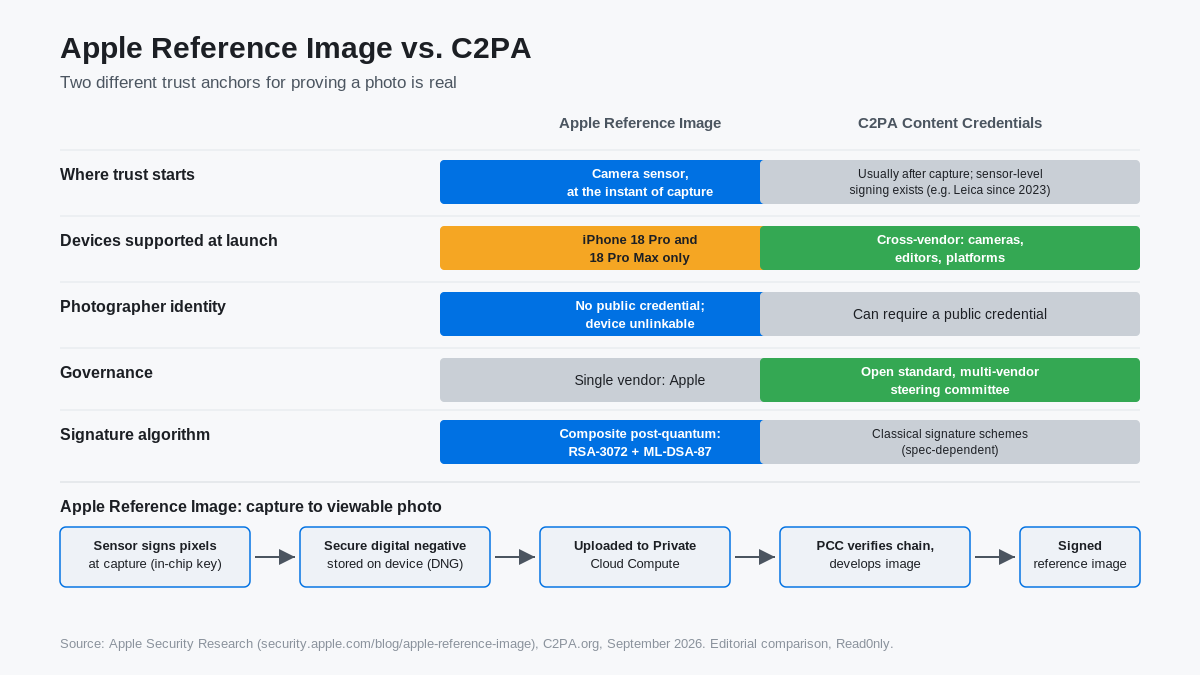
Apple Reference Image is a new, opt-in iPhone camera mode that cryptographically signs a photograph at the moment of capture, then develops it inside Apple’s Private Cloud Compute, producing a picture whose authenticity can be checked without identifying the photographer or their device. It ships on the iPhone 18 Pro and iPhone 18 Pro Max only.
The problem Apple says it is solving
Apple frames Reference Image as a response to a specific weakness it identifies in existing photo-provenance systems. C2PA, the Linux Foundation-backed standard whose Content Credentials specification counts Adobe, Amazon, the BBC, Google, Meta, Microsoft, OpenAI, Sony and TikTok among its steering committee members, is described by Apple as a system that attaches provenance metadata to an image after it is captured, then certifies the chain of edits from that point onward.[1][4] Apple’s post argues this leaves an exploitable gap: if the capture step itself is never cryptographically anchored, “this approach… is vulnerable to compromise at any point in the editing chain, and a viewer has no way to detect such a failure.”[1] Apple also raises a privacy objection to schemes that tie an image to a photographer’s public credential, arguing this “can create privacy risks for photographers working in dangerous conditions.”[1]
That framing describes a common C2PA deployment pattern, where metadata is attached during editing rather than by the camera itself, but it is not true of every C2PA-compliant device. C2PA’s own specification defines “hard bindings,” cryptographic commitments computed over asset bytes that a claim generator, including camera hardware, can create at the moment a manifest is produced, not necessarily after the fact. Leica has sold cameras built on this capability since 2023, according to the Content Authenticity Initiative’s own account: the M11-P was marketed by Leica and the CAI as “the world’s first production camera to guarantee the source of images through the Content Credentials standard,” and Leica now lists six current models, including the SL3-P and Q3 Monochrom, with the same capture-time signing.[5] Apple’s post does not mention this, and its “after capture” framing, read as a description of C2PA in general rather than of its editing-focused, non-camera deployments, understates what capture-time C2PA hardware already does.
Apple’s proposed fix moves the trust anchor earlier, to the camera sensor itself, and later routes the processing through Private Cloud Compute, the same privacy-preserving cloud infrastructure Apple built for off-device Apple Intelligence requests, which Apple says lets nobody, “not even Apple,” see the data it processes.[1][3]
How it actually works
Apple’s account splits the process into two phases, each carrying what it calls its “strongest protections.”[1]
Capture, the secure digital negative: switching to Reference mode reboots the camera sensor into a specialised, secure capture mode. The sensor firmware is prevented from modifying data once capture begins, and the sensor cryptographically signs the raw pixel data with a private key generated inside the sensor itself at the factory, a key that “never releases” outside the chip.[1] Metadata that does not originate at the sensor, such as digital zoom and exposure, is separately signed by the device’s Secure Enclave Processor. Capture time is bounded on both ends. The lower bound comes from a cryptographic timestamp token that Apple’s push-notification service (APNs) delivers to the device roughly every 15 minutes, riding on an existing APNs heartbeat rather than a request the device separately initiates; the device retains the most recent token it receives. After capture, the device separately requests an upper-bound timestamp. Apple’s account does not specify which of the two timestamp requests, if either alone, is protected by Oblivious HTTP: its only explicit statement is a general one, that “timestamping requests travel over Oblivious HTTP so the timestamp service cannot learn the requesting device’s IP address,” made separately from its descriptions of the two individual bound-fetch mechanisms.[1] The resulting package, pixels, both signatures, both timestamp bounds, and manufacturing-time device identity records, is stored on the device as a DNG-format “secure digital negative,” which Apple says can be shared undeveloped, a workflow it flags as relevant to professional photographers.[1]
Development, verification inside Private Cloud Compute: when a user chooses to develop the negative into a viewable reference image, the device uploads it to PCC, which independently re-verifies the sensor’s signature, the Secure Enclave’s signature, and the factory-issued device manifest that binds the two together, confirming the sensor and Secure Enclave genuinely belong to the same physical iPhone.[1] PCC then checks the two timestamp bounds, substituting a fixed fallback date, 31 March 2026, if the lower bound fails verification, on the reasoning that the feature did not exist before that date.[1] A neural network computes a confidence score assessing whether the image has the physical characteristics expected from a genuine sensor capture, then PCC performs the actual image processing, demosaicing, tone mapping and compression, before hashing the result and submitting it to Apple’s signing service.[1] The finished reference image carries a composite post-quantum signature, and the original digital negative is moved to the device’s deleted-photos folder, auto-purged after 30 days unless the user recovers it.[1]
Viewing and revocation: a reference image is not signed with a credential unique to the photographer or their device. Apple’s stated aim is that “an outside observer cannot determine whether any pair of reference images were taken by the same device.”[1] Instead, a separate revocation service tracks each photo’s confidence score and sensor ID without ever seeing the image content, and can revoke individual photos or every photo from a specific sensor if that sensor is later found to be compromised.[1] Whenever a reference image is displayed, the viewing device checks the image’s signature and confirms it is not on the current revocation list.[1]
Who can actually use it
Apple Reference Image is currently exclusive to two devices: iPhone 18 Pro and iPhone 18 Pro Max, and specifically their main camera sensor.[1] Apple’s announcement does not describe any plan, timeline or technical path to bring the feature to earlier iPhone models, other cameras on the same device, iPad, or any non-Apple hardware. That puts Reference Image in a narrower position than C2PA at the standard level, whose Content Credentials specification is built to work across many vendors’ cameras, editing tools and platforms rather than one manufacturer’s newest phones.[4]
Because the feature depends on custom-signed sensor identities established at the factory and on Private Cloud Compute for development, it cannot be retrofitted to an existing sensor through a software update alone; Apple’s account ties the security guarantees specifically to manufacturing-time key generation.[1] Whether Apple will extend Reference Image to future iPhone models, and whether it requires a specific iOS version beyond what ships with iPhone 18 Pro, is not stated in Apple’s post.
What sets it apart from, and short of, C2PA
Anchoring trust at the sensor is not unique to Apple: C2PA’s specification already permits capture-time hard bindings, and Leica has shipped consumer cameras that create them since 2023.[5] What Apple’s account does appear to add, based on what Apple has published, is a combination no known shipping C2PA camera currently matches: sensor identity certified against a factory-issued device manifest, a dedicated revocation service that can invalidate every photo from a specific compromised sensor, and independent re-verification of the entire signature chain inside a separately audited cloud environment, Private Cloud Compute, rather than trust resting on the camera’s on-device signing alone.[1] Whether that combination is meaningfully stronger than existing capture-time C2PA hardware in practice is not something this article can establish from Apple’s announcement; no independent technical comparison of the two was located.
What Reference Image gives up is reach. C2PA’s Content Credentials are designed as an open, cross-vendor standard adopted by a steering committee spanning camera makers, software vendors, publishers and platforms, so that a credentialed image from any participating tool can be checked anywhere the standard is supported.[4] Reference Image, by contrast, is a proprietary Apple system running only on two 2026 iPhone models, verified through Apple’s own Private Cloud Compute and revocation infrastructure. A photograph taken on any other camera, including older iPhones or a Leica with capture-time Content Credentials, cannot carry an Apple Reference Image signature at all, and an Apple Reference Image cannot be checked by tools built only for the open C2PA standard.
Sources
[1] Apple Reference Image: A New Approach for Verified Photography
[2] Apple Security Research (blog index)
[3] Private Cloud Compute: A new frontier for AI privacy in the cloud
 read0nly