OpenAI has confirmed to CNBC that it is talking to Anthropic and Google about working together on AI safety.[1] A spokesperson said the contact follows a July proposal from Google DeepMind chair Demis Hassabis for a US-led safety standards body.[1] No agreement, formal structure or joint statement has been announced by any of the three companies.
What OpenAI actually confirmed
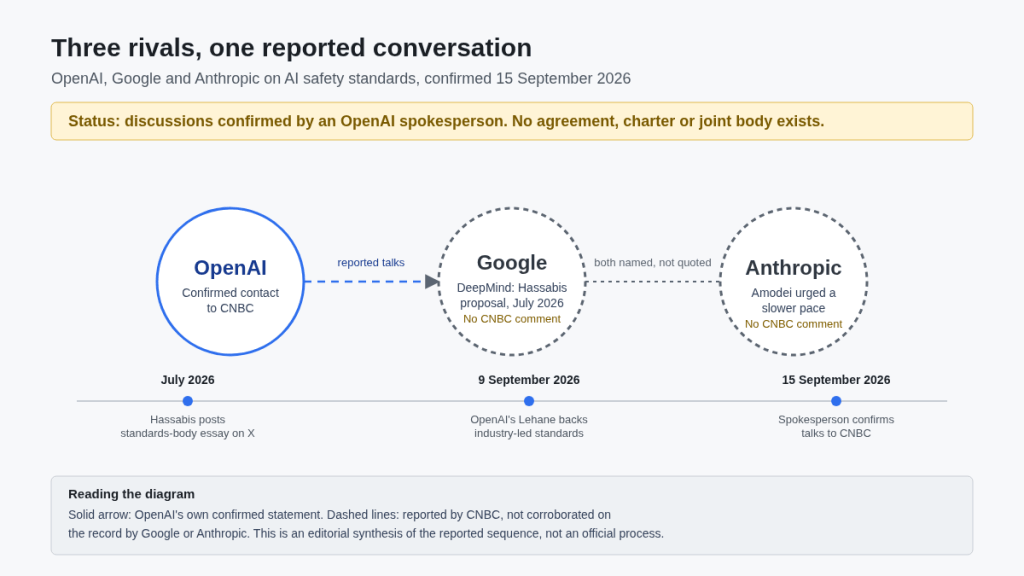
The confirmed fact is narrow: an OpenAI spokesperson told CNBC the company has been “engaging with other AI companies, including Anthropic and Google, about how they can work together to address safety concerns.”[1] That is a statement about contact and discussion, not about a signed agreement, a joint venture or an operational body. CNBC’s article carries no quote from Google or Anthropic confirming the same framing, and both companies did not respond to CNBC’s request for comment by the time of publication.[1] A single-party confirmation of talks with two counterparties who have not corroborated it is a real but limited evidentiary basis, and the article treats it as such.
The Information had reported on the discussions before CNBC’s piece ran, according to CNBC’s own account.[1] That earlier report sits behind a paywall and could not be read in full for this piece; it is treated here only as an attributed detail from CNBC’s reporting on timing, not as independently verified content, since it was not accessible for direct quotation.
The Hassabis proposal and the wider pressure campaign
The trigger for the reported talks is a proposal Hassabis published in July, in an essay on X, calling for a US-led “Standards Body”.[1] CNBC describes the proposal as suggesting either a public-private partnership or a self-regulatory organisation with federal oversight, using the Financial Industry Regulatory Authority as a comparison.[1] That is Hassabis’s own suggested model, reported by CNBC, and it predates and is distinct from the specific three-way contact OpenAI confirmed in September.
The confirmation sits inside a broader pattern of public statements rather than a single isolated event. CNBC reports that Amodei, Anthropic’s chief executive, urged AI companies to slow the pace at which they improve their most advanced models, and that both Hassabis and Altman said publicly they agreed with that direction.[1] Separately, OpenAI’s Chris Lehane wrote in a company blog post on 9 September that OpenAI wants “to work with other labs on industry-led standards”, describing such standards as something that would “complement, not replace, mandatory federal safeguards and democratic oversight”.[2] Lehane’s post is OpenAI’s own policy statement, not confirmation of talks with named competitors, and it does not mention Anthropic or Google by name in that specific passage.
What a “standards body” would and would not be
Nothing in the confirmed reporting describes governance, funding, membership criteria or enforcement mechanisms for the proposed body. Hassabis’s suggested comparison to FINRA points toward a self-regulatory model with some federal oversight link, but CNBC’s report does not say OpenAI, Google or Anthropic have agreed on that structure, or any structure.[1] Lehane’s post frames OpenAI’s preferred approach as industry standards that sit alongside government regulation rather than instead of it, and explicitly ties the effort to work “with or without government support”.[2] That is a stated preference from one company, not a description of what the three-way talks have produced.
The distinction matters because “discussing” and “building” are different evidentiary states. The confirmed fact is discussion. Whether that discussion becomes a body with rules, a voluntary pledge, or nothing durable at all is not something the current reporting resolves.
Editor’s note, added 20 September 2026: a separate, unrelated legal matter touches the same three companies. On 19 September, a proposed class-action lawsuit was filed in the US District Court for the Northern District of California alleging that Anthropic, OpenAI, SpaceXAI and Google made an illegal agreement to slow AI development, built around Dario Amodei’s 12 September essay and the public replies from Sam Altman, Elon Musk and Demis Hassabis.[3] That case concerns alleged coordination on the pace of development, not the standards-body safety talks described above, and none of the four companies had responded to the claim as of the filing.[3] The two stories share the same three companies and the same underlying question of how much AI labs can coordinate with each other, but they are not the same story.
 read0nly
Leave a comment