Britain and Germany announced a partnership on 8 October to counter cyberattacks, sabotage and other hybrid threats.[1][2] The release links it to the countries’ 2025 friendship treaty but leaves practical delivery unspecified.[1][3] Checked 8 October 2026.
The treaty connection
The formal instrument is the Treaty on Friendship and Bilateral Cooperation. Its 2025 implementation record lists 17 projects and a Joint Cabinet review every two years.[3] The UK release calls it the “Kensington Treaty”; a German Federal Government page confirms the nickname and its link to the London signing venue.[1][4]
The release separately lists UK measures, including proscription-like powers and a proposed National Centre for Information Defence. It gives no indication that they form the partnership’s operating structure.[1]
The UK government singles out Russia in its account of the threat. The sources do not establish responsibility for every relevant incident.[1][2]
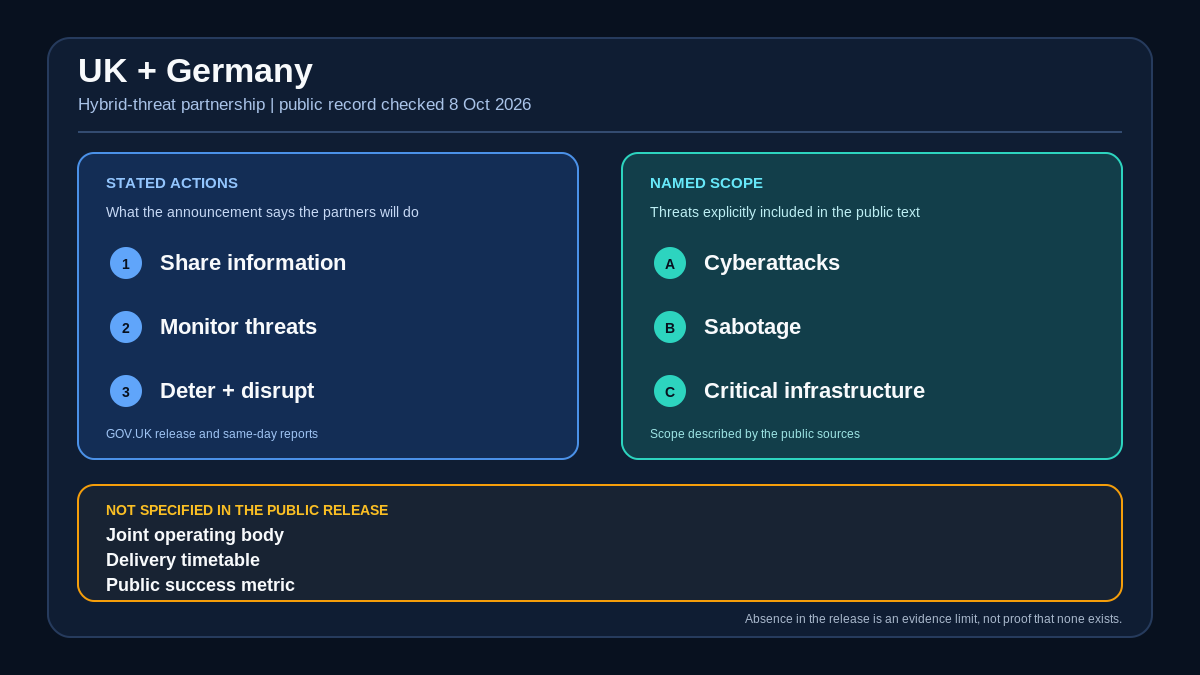
What remains open
The sources name no responsible agencies, incident procedure, command structure, response trigger or public success measure. The checked pages report no disrupted operation, exercise or resilience result for this new partnership.[1][2]
The checked source set contains no German government release on this specific partnership. The UK announcement remains the event source. A useful follow-up would name an implementation lead, set a timetable, document an exercise or response, or publish progress data.
Sources
[1] GOV.UK: UK and Germany launch joint-partnership to counter sabotage and cyber attacks
[2] DW: UK’s Burnham to meet with Merz in Berlin
[3] GOV.UK: Friendship and Bilateral Cooperation Treaty projects
[4] Federal Government: Press conference with Merz and Starmer in London

