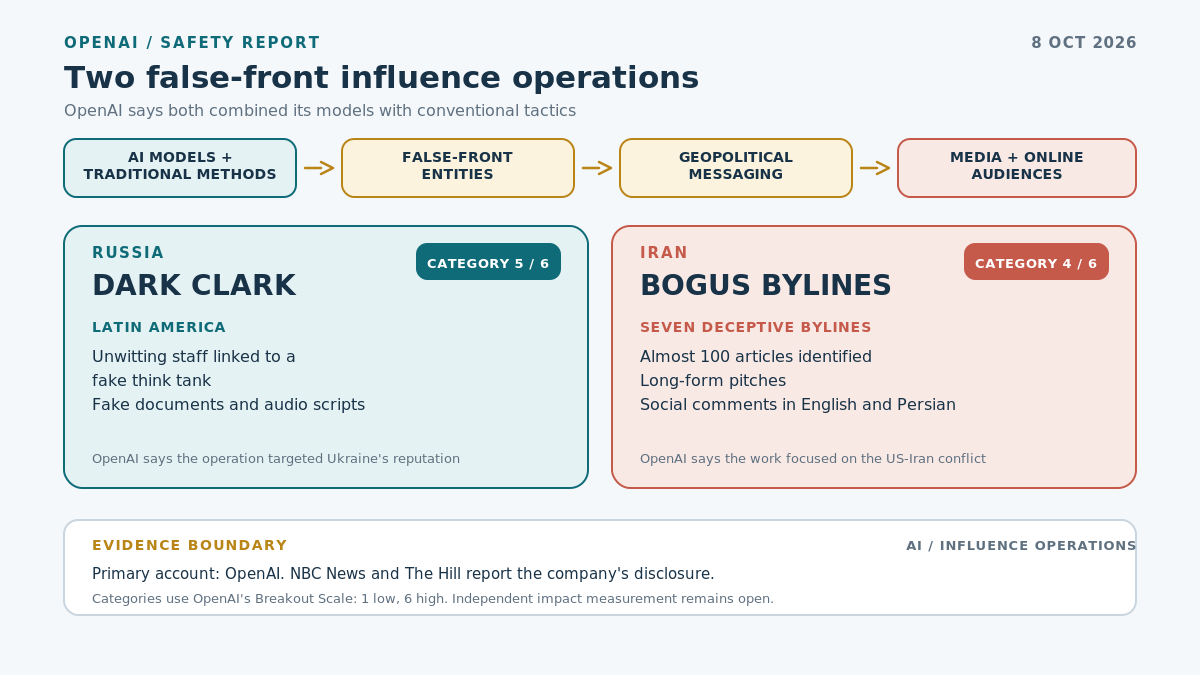
OpenAI says it banned accounts linked to two influence operations, one from Russia and one from Iran, that combined its models with conventional techniques to run false-front entities and circulate geopolitical messaging. The company named the Russian operation Dark Clark and the Iranian campaign Bogus Bylines, assigning them Category 5 and Category 4 on its six-point Breakout Scale.[1][2][3]
Dark Clark used a false think tank
OpenAI says Russian operators created reports about a self-described Social Research Center and controlled it through a fake persona called Mia Clark. It says Latin American staff were unaware of the Russian link. The operation targeted Ukraine’s reputation and local politics, while its reports described fake documents and audio scripts.[1] NBC News reported claims that it tricked schools and heightened tensions between Ukraine and Poland.[2]
Bogus Bylines moved through published articles
OpenAI says Iranian operators used seven bylines to pitch English articles and generate comments in English and Persian. It identified almost 100 articles across more than a dozen online outlets and rated the journalistic workstream Category 4.[1] The Hill reported VPNs, fake American freelance-writer personas and stories tied to the US-Iran conflict, attributing the details to OpenAI.[3]
A disclosure with a clear limit
OpenAI’s report is the primary account. NBC News and The Hill add context and attribute the reconstruction to the company.[1][2][3] The reviewed coverage leaves the full reach and effect unresolved. Assessing it would require records from platforms, outlets, affected institutions and open-source investigators.
Sources
[1] Disrupting AI-enabled false-front operations | OpenAI
[2] OpenAI says Russian influence operation targeting Latin America used ChatGPT
[3] OpenAI disrupts major Iranian, Russian influence operations | The Hill

