Problem. Repeated membership tests over a Python list compare candidate elements in order, so a miss examines every element in this workload.[6]
Baseline. Python’s CPython complexity table lists x in l as O(n), while x in s is O(1) on average and can degrade when hash collisions are severe.[1]
Solution. Build a set once, then reuse x in values_set for the repeated checks. CPython v3.13.5 computes an initial set probe from the key’s hash and table size.[4]
Measured result. At n = 32,768, 1,000 absent queries took a median 1,404.417 ms with a list and 0.061351 ms with a set, a 22,891.52× ratio between those medians on this host.
Reproduce the result
Complete code
from __future__ import annotationsimport gcimport platformimport statisticsimport sysimport timefrom collections.abc import Callable, IterableSEED = 20261021SIZES = (64, 512, 4096, 32768)SCENARIOS = ("hit_front", "hit_middle", "hit_end", "miss")QUERY_COUNT = 1_000WARMUPS = 1TRIALS = 5def values_for(size: int) -> list[int]: return [SEED + index * 1_000_003 for index in range(size)]def queries_for(values: list[int], scenario: str) -> list[int]: if scenario == "hit_front": target = values[0] elif scenario == "hit_middle": target = values[len(values) // 2] elif scenario == "hit_end": target = values[-1] elif scenario == "miss": target = SEED - 1 else: raise ValueError(f"unknown scenario: {scenario}") return [target] * QUERY_COUNTdef count_list_hits(collection: list[int], queries: Iterable[int]) -> int: hits = 0 for query in queries: if query in collection: hits += 1 return hitsdef count_set_hits(collection: set[int], queries: Iterable[int]) -> int: hits = 0 for query in queries: if query in collection: hits += 1 return hitsdef measure( collection: list[int] | set[int], queries: list[int], contains: Callable[[list[int] | set[int], Iterable[int]], int],) -> tuple[list[float], int]: samples: list[float] = [] result: int | None = None for trial in range(WARMUPS + TRIALS): started = time.perf_counter_ns() current = contains(collection, queries) elapsed_ms = (time.perf_counter_ns() - started) / 1_000_000 if result is None: result = current elif current != result: raise AssertionError(f"hit count changed between trials: {result} != {current}") if trial >= WARMUPS: samples.append(elapsed_ms) assert result is not None return samples, resultdef main() -> None: gc_was_enabled = gc.isenabled() gc.disable() try: results: dict[tuple[str, str, int], tuple[list[float], int]] = {} for size in SIZES: values = values_for(size) list_collection = list(values) set_collection = set(values) for scenario in SCENARIOS: queries = queries_for(values, scenario) list_outcomes = [query in list_collection for query in queries] set_outcomes = [query in set_collection for query in queries] if list_outcomes != set_outcomes: raise AssertionError(f"membership outcomes differ for n={size} scenario={scenario}") results[("list", scenario, size)] = measure(list_collection, queries, count_list_hits) results[("set", scenario, size)] = measure(set_collection, queries, count_set_hits) finally: if gc_was_enabled: gc.enable() print(f"python={sys.version.split()[0]}") print(f"implementation={platform.python_implementation()}") print(f"platform={platform.system()} {platform.release()}") print(f"machine={platform.machine()}") print(f"seed={SEED}") print(f"sizes={','.join(str(size) for size in SIZES)}") print(f"scenarios={','.join(SCENARIOS)}") print(f"query_count={QUERY_COUNT}") print(f"warmups={WARMUPS}") print(f"trials={TRIALS}") print("timer=time.perf_counter_ns; collection_build_outside_timing=True; gc_disabled_during_timing=True") print("correctness=all_query_outcomes_match") print("method,scenario,size,expected_hits,median_ms,per_query_us,samples_ms,hits") expected_hits = {scenario: QUERY_COUNT if scenario != "miss" else 0 for scenario in SCENARIOS} for method in ("list", "set"): for scenario in SCENARIOS: for size in SIZES: samples, hits = results[(method, scenario, size)] if hits != expected_hits[scenario]: raise AssertionError(f"unexpected hit count for {method} {scenario} n={size}") median_ms = statistics.median(samples) per_query_us = median_ms * 1_000 / QUERY_COUNT sample_text = ",".join(f"{sample:.6f}" for sample in samples) print( f"{method},{scenario},{size},{expected_hits[scenario]},{median_ms:.6f}," f"{per_query_us:.6f},{sample_text},{hits}" ) size = SIZES[-1] list_median = statistics.median(results[("list", "miss", size)][0]) set_median = statistics.median(results[("set", "miss", size)][0]) print(f"headline_size={size}") print(f"headline_scenario=miss") print(f"headline_speedup={list_median / set_median:.2f}x")if __name__ == "__main__": main()
Command
$ python3 membership_benchmark.py
Output
python=3.13.5implementation=CPythonplatform=Linux 6.12.47+rpt-rpi-v8machine=aarch64seed=20261021sizes=64,512,4096,32768scenarios=hit_front,hit_middle,hit_end,missquery_count=1000warmups=1trials=5timer=time.perf_counter_ns; collection_build_outside_timing=True; gc_disabled_during_timing=Truecorrectness=all_query_outcomes_matchmethod,scenario,size,expected_hits,median_ms,per_query_us,samples_ms,hitslist,hit_front,64,1000,0.110202,0.110202,0.112666,0.110999,0.109980,0.110202,0.110073,1000list,hit_front,512,1000,0.115111,0.115111,0.115111,0.113739,0.113481,0.115221,0.115444,1000list,hit_front,4096,1000,0.110221,0.110221,0.110221,0.110333,0.110259,0.110036,0.109962,1000list,hit_front,32768,1000,0.109480,0.109480,0.109906,0.109814,0.109480,0.109425,0.109314,1000list,hit_middle,64,1000,0.806550,0.806550,0.816679,0.806550,0.806475,0.806420,0.824105,1000list,hit_middle,512,1000,6.057509,6.057509,6.043305,6.051787,6.058472,6.057509,6.224674,1000list,hit_middle,4096,1000,49.831487,49.831487,50.202132,49.690507,49.752895,49.831487,50.150633,1000list,hit_middle,32768,1000,551.365725,551.365725,573.366426,551.365725,550.351215,547.877994,577.106269,1000list,hit_end,64,1000,1.465803,1.465803,1.483322,1.465803,1.474044,1.465581,1.465360,1000list,hit_end,512,1000,11.801243,11.801243,11.801243,11.781169,11.770669,13.330545,12.182425,1000list,hit_end,4096,1000,110.442781,110.442781,116.837120,146.718446,110.442781,98.773055,98.328688,1000list,hit_end,32768,1000,1152.719627,1152.719627,1252.630099,1151.290711,1201.644622,1152.719627,1139.926412,1000list,miss,64,0,1.420026,1.420026,1.431100,1.419211,1.418749,1.435248,1.420026,0list,miss,512,0,11.689040,11.689040,11.689040,11.677855,11.713373,11.746280,11.664965,0list,miss,4096,0,89.526886,89.526886,89.292610,89.250073,90.366917,90.130214,89.526886,0list,miss,32768,0,1404.417440,1404.417440,1415.528872,1404.417440,1409.059832,1361.327792,1124.903441,0set,hit_front,64,1000,0.115036,0.115036,0.117517,0.115481,0.115036,0.114907,0.115018,1000set,hit_front,512,1000,0.130592,0.130592,0.130721,0.148184,0.128092,0.130592,0.127537,1000set,hit_front,4096,1000,0.115943,0.115943,0.115981,0.115943,0.115703,0.116777,0.115647,1000set,hit_front,32768,1000,0.115999,0.115999,0.115869,0.115721,0.179258,0.116592,0.115999,1000set,hit_middle,64,1000,0.116054,0.116054,0.118573,0.116240,0.116036,0.115999,0.116054,1000set,hit_middle,512,1000,0.118258,0.118258,0.118684,0.114648,0.163647,0.118258,0.117333,1000set,hit_middle,4096,1000,0.122203,0.122203,0.122165,0.122259,0.121888,0.122203,0.122351,1000set,hit_middle,32768,1000,0.121888,0.121888,0.121888,0.122017,0.121666,0.122259,0.121536,1000set,hit_end,64,1000,0.116647,0.116647,0.118350,0.116740,0.116647,0.116573,0.116647,1000set,hit_end,512,1000,0.117702,0.117702,0.117888,0.117888,0.117611,0.117647,0.117702,1000set,hit_end,4096,1000,0.122092,0.122092,0.122314,0.122351,0.122073,0.122092,0.122073,1000set,hit_end,32768,1000,0.123462,0.123462,0.123592,0.123462,0.154370,0.122480,0.122592,1000set,miss,64,0,0.066814,0.066814,0.067036,0.066814,0.066833,0.066703,0.066722,0set,miss,512,0,0.073629,0.073629,0.073629,0.078684,0.073685,0.073444,0.073295,0set,miss,4096,0,0.061314,0.061314,0.061518,0.061573,0.061314,0.061277,0.061241,0set,miss,32768,0,0.061351,0.061351,0.061611,0.061407,0.061351,0.061240,0.061203,0headline_size=32768headline_scenario=missheadline_speedup=22891.52x
Environment
The run used CPython 3.13.5 on Linux 6.12.47+rpt-rpi-v8 with an aarch64 processor. The benchmark uses only the Python standard library. It times the membership loop with time.perf_counter_ns(), which returns nanoseconds and avoids the precision loss of floating-point seconds.[3]
Methodology
The script checks every boolean outcome from the list and set for each scenario before collecting timings. It tests collections of 64, 512, 4,096 and 32,768 integers with four deliberate query positions: a hit at the front, a hit in the middle, a hit at the end and an absent value. Each case runs 1,000 identical queries, one untimed warm-up and five timed trials. The list and set are built before the timer starts. Garbage collection is disabled during the timed calls and restored afterwards. The output keeps all five samples and reports their median.
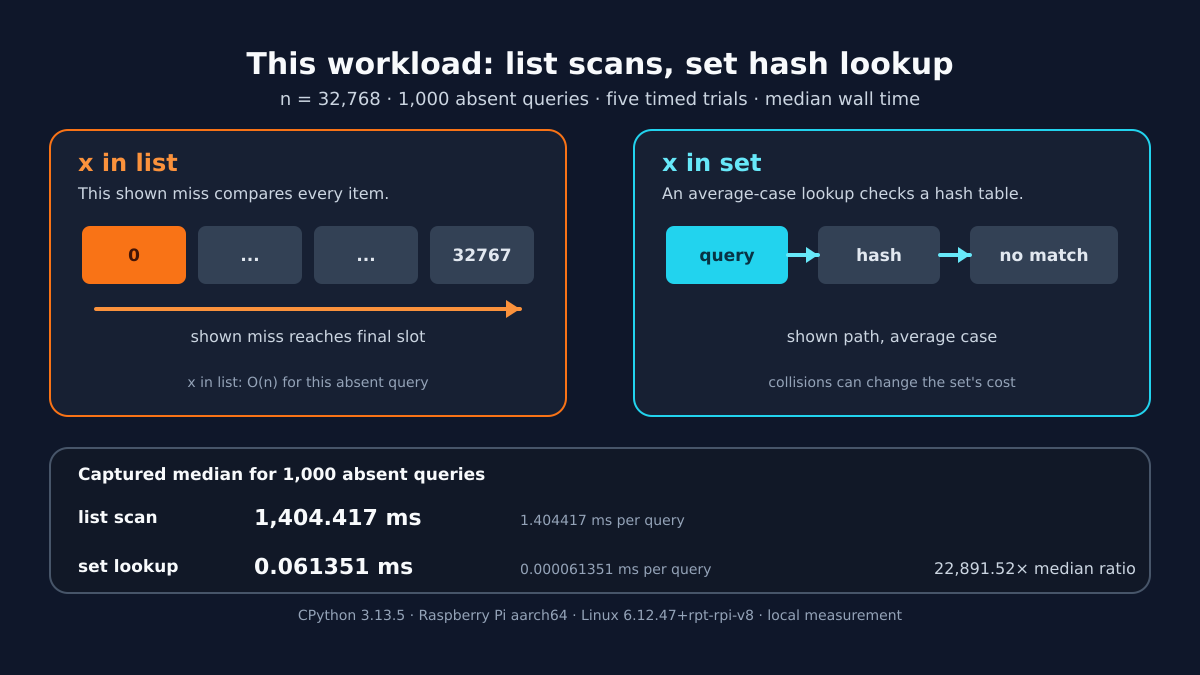
The problem
A membership test asks whether a value occurs in a collection. In the CPython v3.13.5 list implementation used for this discussion, the containment loop checks items in order and returns when comparison succeeds or when it reaches the end.[6] An absent query therefore has no early exit in that loop.
That makes a short expression such as if record_id in records sensitive to the collection’s size and to where a match appears. The code is tidy. The scan underneath may be doing rather more walking than the line suggests.
Baseline complexity
The measured list cases make the exit position visible. At n = 32,768, a front hit took 0.109480 ms for 1,000 queries, a middle hit took 551.365725 ms, an end hit took 1,152.719627 ms and a miss took 1,404.417440 ms. The output reports the median values from the five trials.
The complexity page describes x in l as O(n) and x in s as O(1) for the average case. It also states that set operations can become O(n) in the worst case when collisions are severe.[1] Those are growth descriptions, not timing predictions for this Raspberry Pi.
The solution
A set trades sequence order for membership-oriented storage. Python’s tutorial lists membership testing among its basic uses and notes that a set contains distinct elements.[2] The set must be built before the repeated lookup loop, and its elements must be hashable.[5]
The CPython v3.13.5 implementation begins a lookup from the key’s hash modulo the table size, then probes according to its collision-handling rules.[4] The benchmark measures only the repeated in operations. Set construction and the memory it occupies are outside the timer, so the result answers a narrow question: what happens when an already-built collection receives many membership checks?
What the measurement shows
The list and set returned identical boolean outcomes for every query in all four scenarios. List time stayed almost flat for a front hit because the first comparison succeeds. Middle, end and absent queries became more expensive as the collection grew. Set medians stayed close together across sizes in this run, including the absent-query case.
The headline ratio is large because the workload combines a 32,768-item scan with 1,000 misses, while the set is already built. It is a useful boundary result for that workload, not a conversion factor for every membership test.
Practical applications
A parser that repeatedly checks whether an identifier has already been seen can keep those identifiers in a set. The lookup mechanism matches the question, while the original input list can remain separate when order matters. This benchmark measures the membership operation, not parsing or input conversion.
A graph traversal commonly keeps a visited set so each discovered vertex can be checked before it is queued again. The set avoids rescanning the visited collection on every edge, but the article does not measure graph construction, adjacency storage or traversal order.
An allowlist or blocklist can use a set when the values are hashable and the list is rebuilt infrequently relative to the number of checks. Rebuilding the set for every single query would move its construction cost into the workload and change the decision.
A batch filter can first build a set of accepted IDs, then test incoming rows with item_id in accepted. If the result must preserve the allowlist’s order or support slicing, retain a list as well because sets do not provide sequence indexing.[5]
Where it stops helping
This experiment uses integers, one process and repeated identical queries. It does not measure set construction, memory usage, custom objects, adversarial hash collisions, concurrent access or a mixed hit distribution. The host runs one CPython build, and the official complexity page warns that other Python implementations can have different performance characteristics.[1]
The practical choice depends on the full workload. Keep a list when order, duplicates, indexing or slicing are part of the data model. Build a set when repeated membership checks dominate and the extra storage and hashability requirement fit the program.
Sources
[1] Python 3.15 time complexity of operations on built-in types
[2] Python 3.15 data structures tutorial

