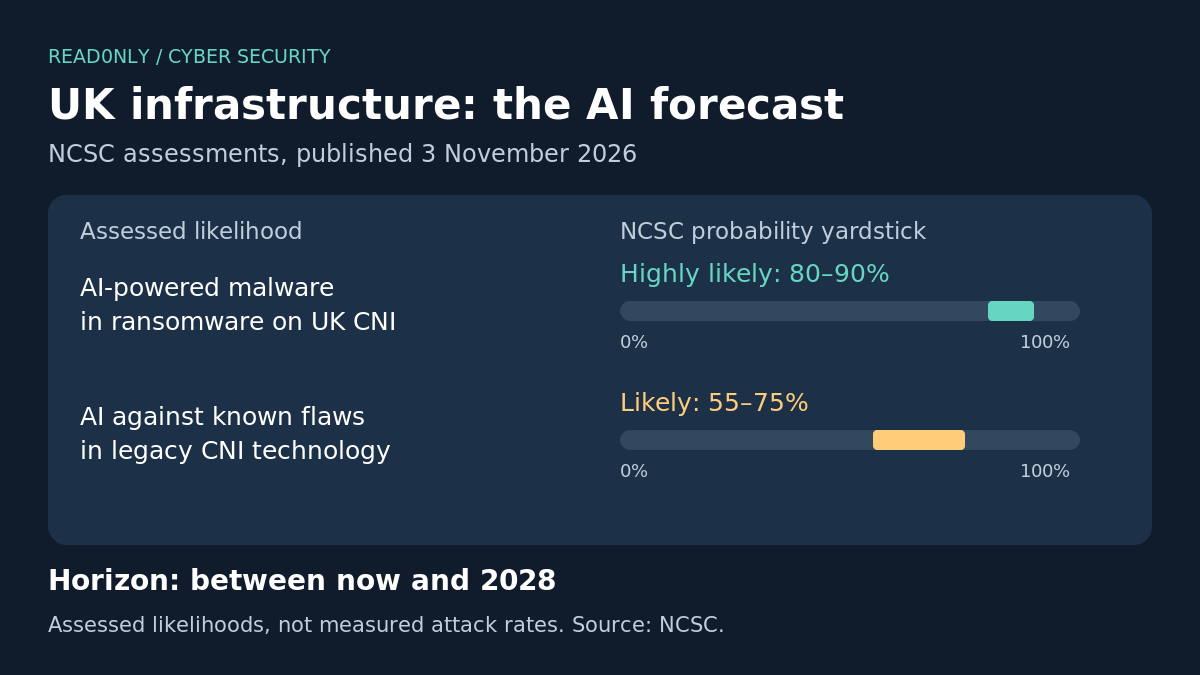
Britain’s National Cyber Security Centre assesses it as “highly likely” that AI-powered malware will have been used in a ransomware attack on UK critical national infrastructure between now and 2028. Its assessment, published on 3 November 2026, sets out a future risk to essential services, with the outcome still uncertain.[1]
What “highly likely” means
Under the NCSC’s probability yardstick, “highly likely” corresponds to 80–90%.[1] That range expresses an assessed likelihood of an event occurring, rather than the proportion of infrastructure expected to be attacked.[1] The same assessment uses the lower term “likely” for attackers applying AI capabilities against known vulnerabilities in legacy critical infrastructure by 2028.[1]
AI assistance across an operation is broader than AI-powered malware. The NCSC separately expects AI adoption to increase the scale and efficiency of hostile activity, including social engineering and vulnerability exploitation.[2] AP reports that the emphasis is on enhancing existing tactics; Sky News independently covers the warning and describes AI being used to identify vulnerabilities, select targets and improve operational efficiency.[3][4] Both outlets report the agency’s assessment; their coverage cannot establish the future outcome.
The choices behind the forecast
The NCSC examines baseline, pessimistic and optimistic scenarios, describing them as plausible possibilities.[1] Its optimistic case envisages replacement of ageing systems, better workforce education and effective defensive security measures.[1] These alternatives make the pace of defensive improvement a central condition in the assessment.
For organisations, the accompanying NCSC release calls for urgent investment, removal of unnecessary internet connections and resilience proportionate to size, complexity and risk.[2] It describes Cyber Essentials as a starting point, with further work needed beyond that baseline.[2]
Sources
[1] Artificial intelligence and cyber intrusion | National Cyber Security Centre
[3] Associated Press via ABC News: UK cyber chief warning
[4] Sky News, Tom Cheshire: Prepare for cyber attacks or face empty shelves

