The US Office of the Comptroller of the Currency issued an AI supervisory framework on 4 November 2026 to help examiners assess banks’ everyday use of the technology. Its bulletin explicitly rules out new supervisory expectations, enforceable standards or prescriptive requirements, and says banks are not expected to use the guide for self-assessment.[1]
Who it covers
The bulletin defines banks as national banks, federal savings associations, and federal branches and agencies of foreign banking organisations.[1] Community-bank examinations should be tailored to size, complexity and risk profile, proportionate to the nature, consequences, autonomy and complexity of the use cases.[1]
The OCC calls the technology “Super Intelligence”, encompassing technologies previously described as artificial intelligence.[1] The framework’s first footnote says it is more applicable to generative and agentic systems, while existing model-risk principles apply to non-generative, non-agentic models.[2]
Consequences guide the assessment
The six pillars cover purpose, risk, control, oversight, resilience and assurance.[2] The framework says a simple agent authorised to initiate transactions could present greater risk than a sophisticated model restricted to internal writing assistance.[2] Its illustrative table places autonomous payment agents in Tier 1, Critical, and internal productivity tools in Tier 4, Low.[2]
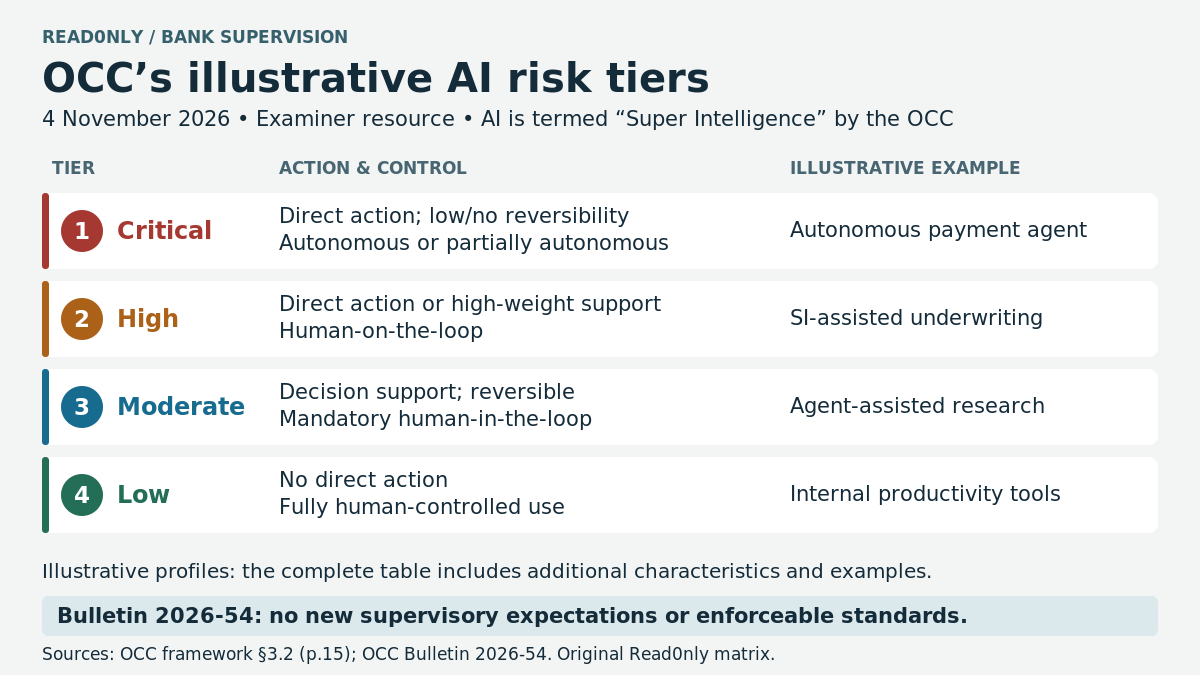
Human involvement also has a practical meaning: approval before an action differs from active monitoring with the ability to intervene.[2] The guide says a named reviewer may need the expertise, information and authority to reject, pause or halt a system’s output or action.[2]
ABA Banking Journal’s same-day report relays the OCC’s announcement and banking-use examples.[3] For a bank assessing the significance of the release, a useful first question is what an AI system can actually do with its permissions. The next is whether an erroneous action can be contained or reversed.


Leave a Reply