Google announced TPU 8tx and TPU 8i Max on 9 November, adding confidential inference and long-context configurations to its eighth-generation accelerator family.[1] Bloomberg reports that availability is planned for 2027, citing Google chip chief Amin Vahdat; the announcement describes system changes around existing silicon.[2][1]
Two different system changes
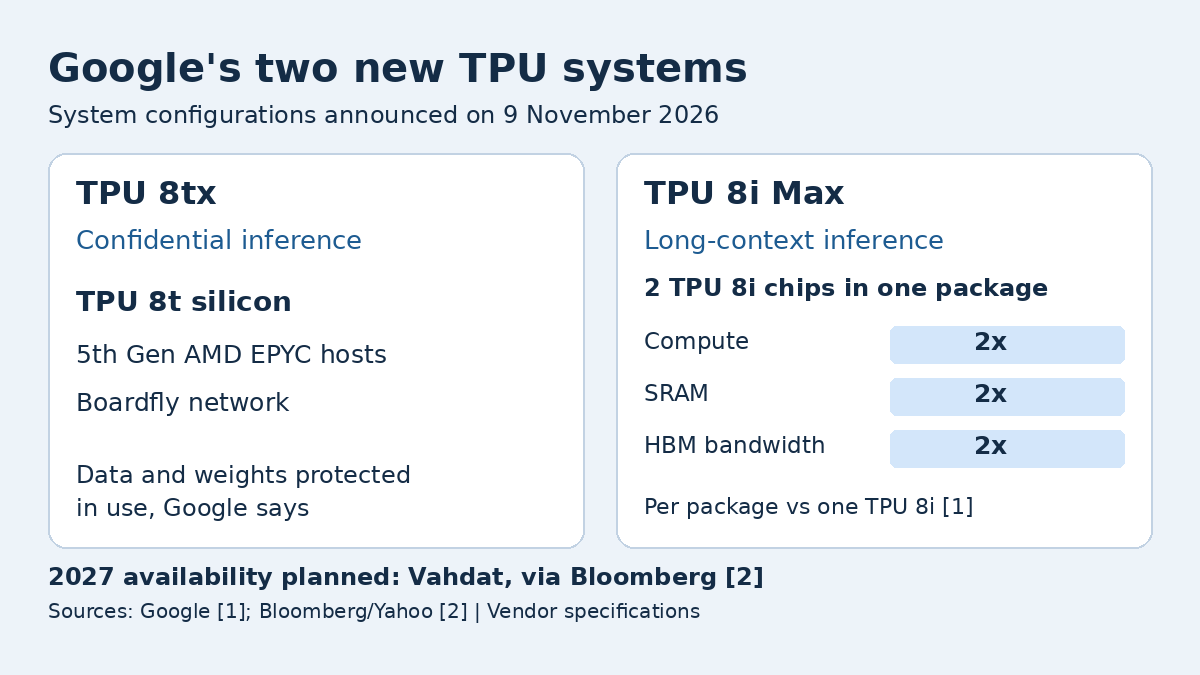
TPU 8tx uses TPU 8t silicon with fifth-generation AMD EPYC host CPUs and Google’s low-latency Boardfly network.[1] Google says hardware isolation protects sensitive data and model weights during processing, and supports private fine-tuning, distillation and reinforcement learning on the same system.[1]
The announcement leaves attestation procedures and excluded attacks unspecified. Its security description alone cannot establish protection against prompt injection or unsafe agent actions.
TPU 8i Max combines two TPU 8i chips in one package.[1] Google claims twice the compute, on-chip SRAM and high-bandwidth memory bandwidth of TPU 8i, with twice the silicon in the existing rack footprint.[1] The stated doubling concerns those resources; Google’s announcement gives no HBM capacity for the new package.
What the comparisons establish
The package-level resource increase provides no measured end-to-end speed-up by itself. Google also claims up to “2x lower latency” for 8tx against TPU 8t, but its announcement supplies no model, precision, batch size or workload for that comparison.[1]
The timing accounts need separate attribution: Bloomberg quotes Vahdat pointing to next year, while TechTarget reports that Google supplied no availability dates or pricing.[2][3] Google’s announcement itself contains no delivery schedule.
Jump Trading CTO Alex Davies told Bloomberg that TPUs work well for a subset of tasks; the firm still mainly uses Nvidia for training.[2]
Sources
[1] Introducing TPU 8tx and TPU 8i Max
[2] Google Escalates Nvidia Rivalry With Specialized Versions of AI Chips
[3] Google specializes TPUs for agentic, confidential computing | TechTarget


Leave a Reply