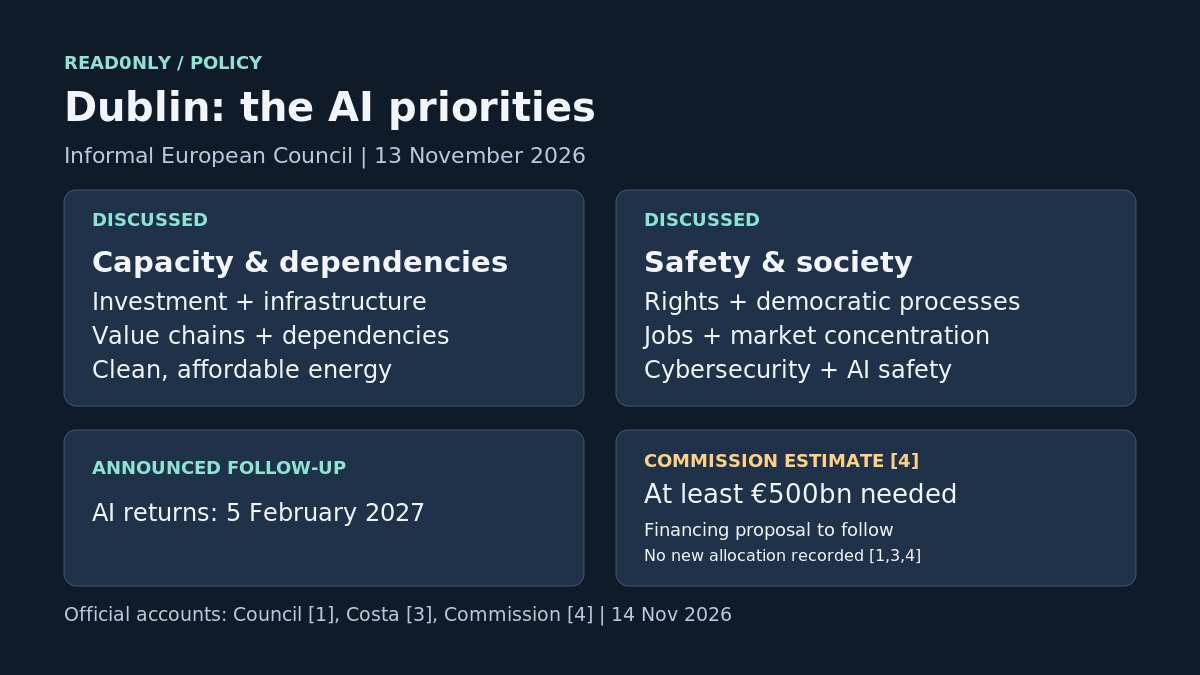
EU leaders held a strategic discussion on artificial intelligence in Dublin on 13 November, covering investment, technological dependencies and safety. Mistral AI chief executive Arthur Mensch and AI researcher Geoffrey Hinton joined the informal European Council meeting, which examined competitiveness alongside the technology's effects on society.[1]
Capacity and control
Von der Leyen promised an “ambitious proposal” on tech-sovereignty financing, pointing to investment gaps in chips, computing and frontier AI, and calling for private investment.[4] Her statement gives no time horizon for the €500 billion estimate.
The Council results, Costa's remarks and von der Leyen's statement record no newly approved AI funding allocation. Comparing them separates estimated investment needs, a promised financing proposal and decisions adopting expenditure.
The economic session considered securing value chains, reducing critical dependencies and accelerating AI adoption by companies and public administrations.[1] Costa cited existing initiatives, including the savings and investments union and the so-called 28th regime.[1]
Euronews, reporting with AFP, described reducing reliance on foreign technology as a driving concern, citing Estonia's prime minister, Kristen Michal, urging investment in new technologies.[2]
Safeguards and the next discussion
The session with Hinton covered children's rights, democratic processes, market concentration and international safeguards for advanced AI.[1] Costa presented oversight as a condition for public trust and called for EU involvement in governance through the G7, G20 and United Nations.[3]
Costa said leaders would return to AI at Alden Biesen on 5 February 2027, with AI's societal effects also planned as the central theme of the 2027 Social Summit.[3]
Sources
[1] European Council: Dublin meeting results
[2] Euronews and AFP: EU leaders discuss AI in Dublin
[3] European Council: Costa press conference remarks
[4] European Commission: von der Leyen Dublin press conference statement


Leave a Reply