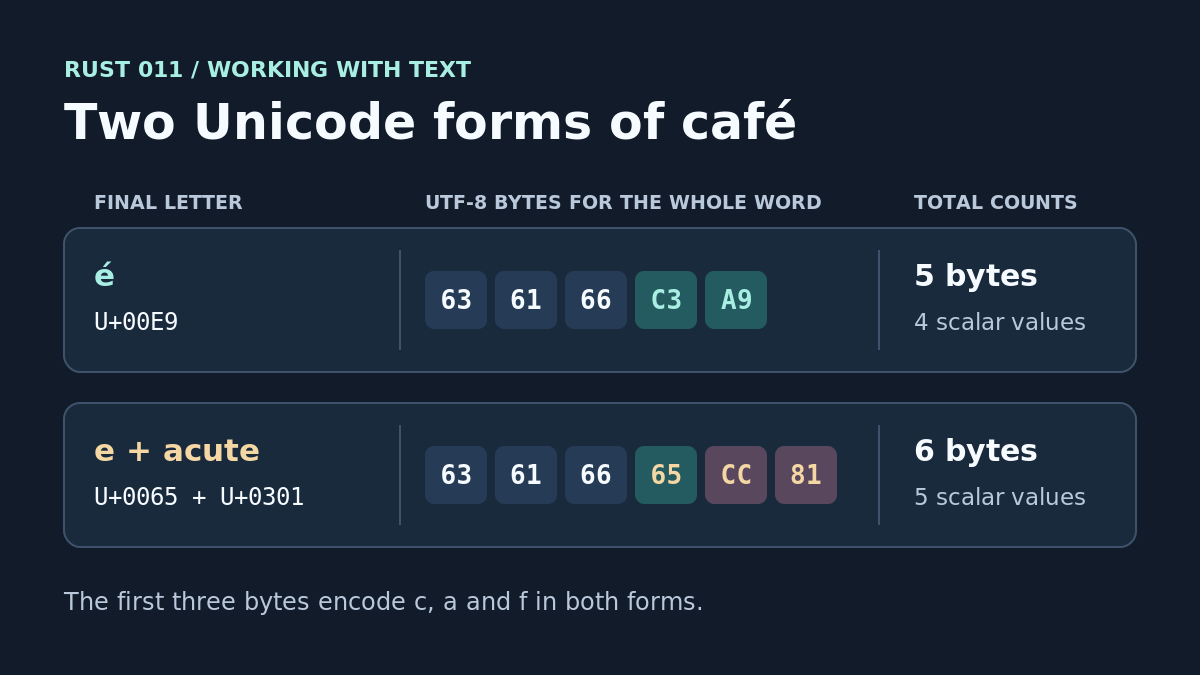
Say your programme needs to count the characters in café. Four looks like the obvious answer. Ask Rust for the size in bytes and you get five. Decide which count the programme needs before choosing a method.
A String owns UTF-8 text and can grow. To add the final é to caf, the programme uses push on a mutable String.[1] A &str is a shared view of UTF-8 text. A string literal already has that form.[1]
The counts function takes a &str. It accepts a borrow of word in the first call and a literal in the second. Both calls use the same function, and main keeps ownership of word.
On a &str, len() gives the byte count. chars() yields Rust char values, one per Unicode scalar value, so chars().count() counts those values.[2]
Create a Cargo project, then open its text-counts directory for the rest of the lesson.
cargo new --vcs none text-counts
$ cargo new --vcs none text-counts Creating binary (application) `text-counts` packagenote: see more `Cargo.toml` keys and their definitions at https://doc.rust-lang.org/cargo/reference/manifest.htmlexit=0
Replace src/main.rs with this programme and run it.
fn counts(text: &str) { println!("{}: {} bytes, {} scalar values", text, text.len(), text.chars().count());}fn main() { let mut word = String::from("caf"); word.push('é'); counts(&word); counts("cafe\u{0301}");}
cargo run --quiet
$ cargo run --quietcafé: 5 bytes, 4 scalar valuescafé: 6 bytes, 5 scalar valuesexit=0
The first line uses a single scalar value for é. In the second, \u{0301} adds a combining acute accent after e. That spelling uses one extra scalar value and one extra byte.
In either spelling, the accented letter forms one grapheme cluster under Unicode’s default rules. Grapheme clusters approximate what people perceive as single characters.[3]
For a storage limit in bytes, use len(). If a limit is supposed to match what someone sees as a character, count grapheme clusters instead.
Why a single index fails
Rust rejects a single integer index into a String, even when its text contains only ASCII.[1]
Try the failing version by temporarily replacing src/main.rs and running the check below.
fn main() { let word = String::from("café"); let first = 0; println!("{}", word[first]);}
cargo check --quiet
$ cargo check --quieterror[E0277]: the type `str` cannot be indexed by `{integer}` --> src/main.rs:4:25 |4 | println!("{}", word[first]); | ^^^^^ string indices are ranges of `usize` | = help: the trait `SliceIndex<str>` is not implemented for `{integer}` = note: you can use `.chars().nth()` or `.bytes().nth()` for more information, see chapter 8 in The Book: <https://doc.rust-lang.org/book/ch08-02-strings.html#indexing-into-strings>help: `usize` implements trait `SliceIndex<T>` --> /rustc/58cf8f9c35b355199727627d07ae34a4e2846d67/library/core/src/slice/index.rs:179:0 | = note: `SliceIndex<[T]>` --> /rustc/58cf8f9c35b355199727627d07ae34a4e2846d67/library/core/src/bstr/traits.rs:197:0 | = note: `SliceIndex<ByteStr>` = note: required for `String` to implement `Index<{integer}>`For more information about this error, try `rustc --explain E0277`.error: could not compile `text-counts` (bin "text-counts") due to 1 previous errorexit=101
The compiler points to the index and reports E0277. To walk through the scalar values, use chars() as in the working programme.
Try one more input
Restore the working programme. Change the second input to "🙂", predict its two counts, then rerun the same command. The first line should stay the same.
On the test run with Rust 1.99.1, the new input gave four bytes and one scalar value.
The next lesson uses slices to borrow part of a collection.
Browse Rust, one step at a time


Leave a Reply