US export controls can require a licence for certain advanced chips, servers and related items destined for data centres that provide or will provide covered remote access.[1] The Bureau of Industry and Security (BIS) announced the rule on 16 November; it took effect on 19 November 2026.[2][1]
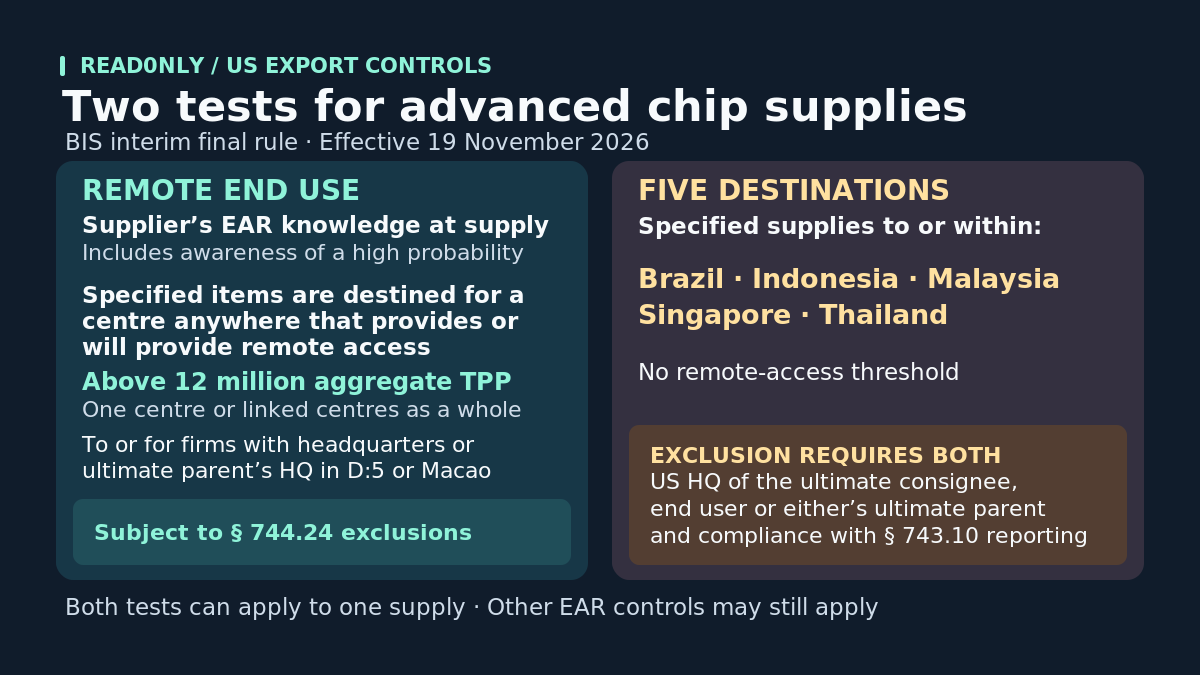
Under § 744.24(a)(1), subject to that section’s exclusions, a licence can be required if the supplier knows under the Export Administration Regulations (EAR), at export, re-export or in-country transfer, that specified items are destined for a centre anywhere that provides or will provide remote access above 12 million aggregate total processing performance (TPP).[3] That means the sum of covered chips’ or equipment’s TPP at one centre or linked centres operating as a whole.[3][4] The access must be to or for firms headquartered in Country Group D:5 (including China) or Macao, or whose ultimate parent is headquartered there.[1][3] EAR knowledge includes awareness of a high probability.[4]
Section 744.24(b)(2) excludes access solely for commercial recommender systems as defined in (d)(1) from that section’s prohibitions, subject to the required submission to BIS.[3] The definition requires exclusive design and use for commercial recommendations.[3] It excludes systems designed or used to generate new content in response to user input, and systems that incorporate those models.[3] Paragraph (b)(3) sets a separate licence requirement for centres seeking to continue significant pre-publication service to covered firms; § 744.23 can still apply.[3]
For foreign centres, Note 3 expects suppliers to obtain and be able to provide sufficient information about the centre’s customer checks for direct or indirect ownership or control by persons located or headquartered in D:5 or Macao, or whose ultimate parent is headquartered there.[1] A refusal or inability to provide enough information creates a presumption of knowledge if the red flag remains unresolved before the transaction.[1][5]
Under § 744.24(e), suppliers must notify recipients of covered supplies made on or after 19 November 2026 without authorisation because the supplier lacked EAR knowledge of a prohibited end use and no other EAR licence requirement applied.[3] The notice must say the transferor must obtain BIS authorisation before switching to covered access and follow the know-your-customer guidance in Supplement No. 3 to Part 732.[3]
Section 742.6(a)(6)(iii)(A)(1) separately covers specified supplies to or within Brazil, Indonesia, Malaysia, Singapore and Thailand without a remote-access threshold.[3] Both tests can apply to the same supply.[3] The five-destination requirement does not apply to supplies to an ultimate consignee or end user headquartered in the US, or whose ultimate parent is headquartered there, provided the exporter, re-exporter or in-country transferor meets the reporting requirements of § 743.10.[3]
Comments are due by 19 January 2027.[1]
Sources
[2] Bureau of Industry and Security: announcement, 16 November 2026
[3] GovInfo: Addressing Remote Access to Advanced Semiconductors (91 FR 74970, official published PDF)
[4] BIS: definitions of knowledge and aggregate TPP in EAR § 772.1
[5] Nixon Peabody: analysis of the data centre and chip supply rule


Leave a Reply